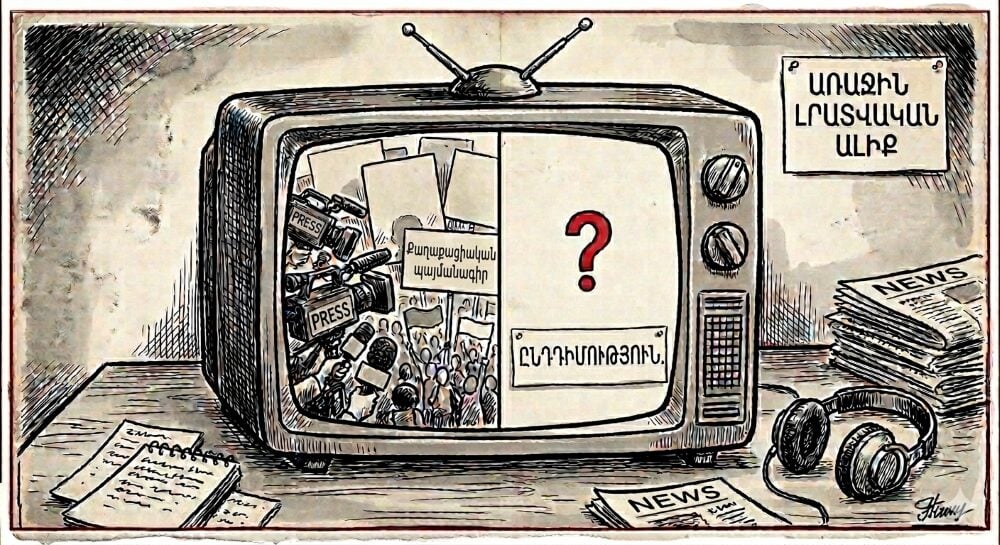

On April 30, the Russian propaganda channel Caucasar claimed that the American International Foundation for Electoral Systems (IFES), which has been operating in Armenia since the 1990s, will assist in rigging the parliamentary elections. The claim was further spread by Rybar, a channel affiliated with Caucasar and one of the largest Russian propaganda channels on Telegram, boasting 1.5 million followers.
Pro-Russian Telegram channels have been spreading claims for months that several Western initiatives and organisations are planning to manipulate the elections in Armenia. This narrative aims to undermine the legitimacy of the election results before they are even announced. It is being propagated not only through Telegram channels but also by official Kremlin sources.
Verified has reviewed several posts on Telegram channels about the elections and found that they exaggerate or misrepresent Armenia’s collaboration with Western institutions. They label this cooperation as an effort by the West to “oversee” the elections, despite lacking a clear justification for these claims.
IFES as the election overseer
The International Foundation for Electoral Systems (IFES) is a non-governmental organisation established in the United States in 1987. It offers consulting and technical assistance to support the conduct of democratic elections. Throughout its history, IFES has worked in approximately 145 countries and currently operates in 45 countries worldwide. A complete list of these countries can be found on the foundation’s website.
Until 2001, the International Foundation for Electoral Systems (IFES) also operated in Russia.
IFES has been active in Armenia since 1995. This detail is mentioned by Caucasar, which claims that three decades later, in 2026, IFES will assist in rigging elections in Armenia. The channel supports this claim by stating that IFES is providing training courses for these elections in partnership with the Swedish International Institute for Democracy and Electoral Assistance (International IDEA). However, this does not verify the claim it is based on. IFES and International IDEA have been cooperating since at least the mid-2010s. Furthermore, International IDEA has been working in Armenia since 2020 and has been implementing related projects since at least 2005.
The Telegram channel is manipulating, claiming that the cooperation with the Swedish organisation somehow proves that IFES decided to help rig the elections in Armenia this year and “provide the donors with the necessary result.”
EU-Armenia program propaganda screening
In recent months, Armenia has been engaging extensively with the EU to counter external hybrid attacks ahead of the elections. In December, the EU announced it would grant Armenia €15 million to support various initiatives aimed at countering external interference. In April, a new EU civilian mission was announced, scheduled to arrive in Armenia for two years, offering strategic advice and capacity-building to various ministries and national institutions. Additionally, in early April, 60 cybersecurity specialists gathered in Yerevan to participate in the Armenia-Estonia Cyber Shield exercise.
All this aligns with the government’s 2024-2026 concept for combating disinformation, which emphasises cooperation with international partners. The document also mentions coordinated and hybrid campaigns in cooperation with foreign states.
The opposition, however, emphasises that such programs with the EU can be used to enhance the government’s authority during elections rather than to combat disinformation impartially.
The above-mentioned post by Caucasar is part of a series of publications from pro-Russian channels that frame the Armenian elections within the context of Western “governance.” In these publications, the growing collaboration between the European Union and Armenia in combating disinformation is portrayed as an attempt to manipulate and undermine the electoral process.
For example, the EU-Armenia summit and the European Political Community summit, scheduled for May in Yerevan, have been described by the Telegram channel Tzitzak as “an act of external interference.” The EU regularly holds summits with various partner countries, primarily to enhance economic and political cooperation. The European Political Community summit is not unique; it is the eighth such summit, with previous meetings held in Albania, Spain, Hungary, and Moldova, among others. However, the Telegram channel does not explain why these summits are considered “external interference” in the case of Armenia.
The channels frequently recycle old stories and conspiracy theories that have been previously refuted, suggesting that organisations collaborating with EU structures are part of the “Soros system” (see examples 1, 2). In addition to mentioning Soros, the Caucasar channel refers to various Armenian initiatives that implement social, cultural, and youth programs as “staff organisations” of the West.
The claims and arguments in the studied materials are often unclear. For instance, one publication on the Tzitzak channel at the same time states that the EU will oversee the elections, then the publication claims that Washington will take on this role. Another publication on the Caucasar channel suggests that the elections were “managed” by the British, citing the Armenia-Britain strategic partnership declaration as evidence. However, it’s important to note that Armenia has signed similar declarations with various countries, including its neighbour, Georgia.
The Rybar channel suggested that the European Union’s forthcoming civic mission is linked to concerns from the Armenian authorities about their ability to conduct “fair elections.” This implies that the EU might support electoral injustices in Armenia. The channel claimed that the EU mission would “manage” the electoral process to benefit the ruling party, and that “Eurobureaucracy” would oversee the developments occurring in the Republic of Armenia.
The rationale behind Rybar’s conclusions remains irrational. The new EU mission was officially approved on April 21. Earlier this month, the EU opened applications for specialists for the mission, with a deadline of April 23. The selected specialists will be announced in a month. This means that the mission has not yet arrived in Armenia, and its members will only be revealed at the end of May. Thus, the claim that the mission, whose members were approved just days before the elections, will “oversee” the electoral process is unfounded and lacks factual support.
Armenia’s collaboration with the French state service Viginum, which specialises in studying disinformation and foreign digital campaigns and operates under the French Secretariat of Defence and National Security, was also viewed as a threat to a fair electoral process.
In 2025, political scientist Artur Khachikyan suggested on his Telegram channel that Viginum would assist in suppressing the Armenian opposition. Then, in April 2026, the Rybar channel claimed that the Armenian authorities were relying on Western special services to secure their re-election in the upcoming elections. This involved ceding some of their sovereignty and decision-making power to these services.
Russian organised desinformation is a “myth”
Pro-Russian channels describe the notion of a “hybrid war” against Armenia as a myth, suggesting that the government uses the idea of fighting this war as a pretext for manipulating elections in its favour. Official Moscow also views the notion of a hybrid war as a justification for interfering in the electoral process.
Independent journalists have reported that Russia is actively engaged in propaganda efforts in Armenia (see example 1 and example 2). Furthermore, a 2025 study by DFRLab found that nearly every positive development in EU-Armenia relations was met with negative reactions from both Moscow and Baku, with these responses often aligning closely.
An analysis of posts from Russian-language Telegram channels in 2025 indicates that European programs implemented in Armenia were linked to the electoral process. For instance, the allocation of 1.5 million euros to independent media was portrayed as support for Nikol Pashinyan. Additionally, a program designed to enhance the capabilities of independent media and civil society organisations for election monitoring was interpreted as a means to justify electoral violations benefiting Pashinyan.
A Bloomberg News investigation published on April 28 revealed that allegations of election fraud are a significant aspect of the Russian disinformation campaign. Bloomberg reporters have also documented similar claims concerning the upcoming elections in Armenia.
The various collaborations with Western entities mentioned in the publications we reviewed are often viewed as attempts to undermine the elections. Many of these articles claim that Western forces are conspiring to disrupt a fair electoral process in Armenia. However, these accusations are either unfounded or manipulative.