Amid the decline in searches for betting platforms, the rapid rise in interest in AI, the silent shift to Telegram, and the distancing from the Russian internet, what do the most-searched queries from Armenia reveal?
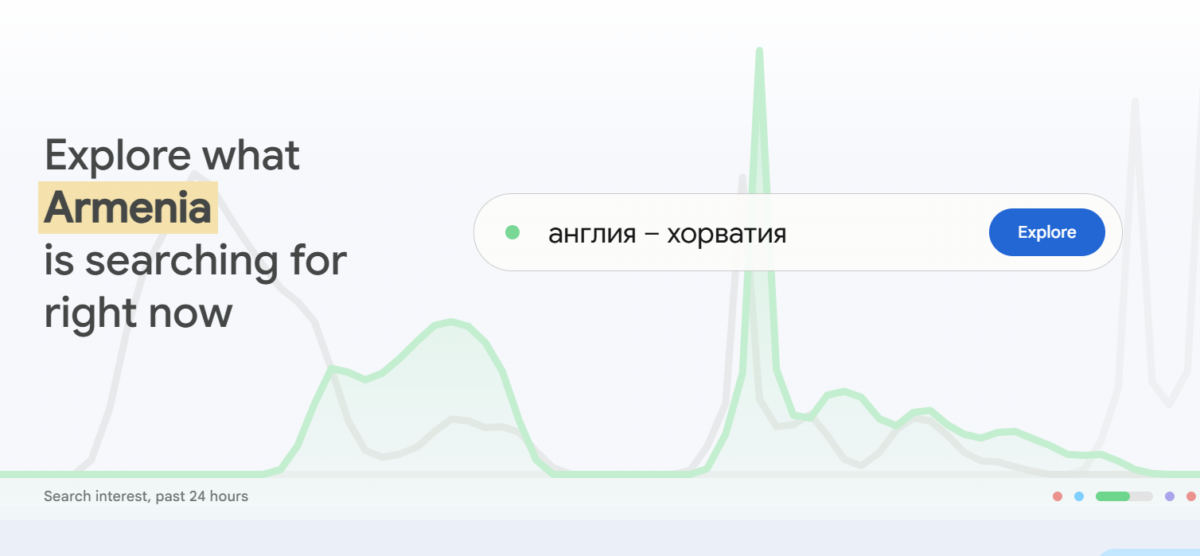
Let’s analyse the most popular topics searched in Armenia during 2025-2026, based on Google Trends data.
Methodology and important notice
The analysis is based on two datasets: the most frequently searched (top) and the fastest-growing (rising) queries, covering the period from January 2025 to the present.
Statistical comparisons were conducted using Google Trends data, which was synthesised and cross-validated by two independent AI tools, Claude Opus and Google Gemini, applied to the same dataset.
Search interest is a normalised relative index ranging from 0 to 100. For instance, the most searched Russian word, “погода” (english: weather), has a value of 100, which serves as the baseline rather than indicating an absolute number of queries.
Weather: most searched topic
The most frequently searched word in Armenia is not politics or news-related; rather, it is the weather. Interestingly, searched in Russian. The query “погода” (English: weather) has the highest index score of 100, while “погода завтра” (meaning: weather tomorrow) has a score of 26.
The same everyday query is repeated in three languages: Russian (погода, 12), English (weather, 12), and Armenian (եղանակ, 8). This simple search exemplifies the trilingual nature of the digital landscape in Armenia. Furthermore, most users likely do not type the query in Russian; instead, their phone’s operating system is set to Russian, allowing them to perform the search with a single tap.
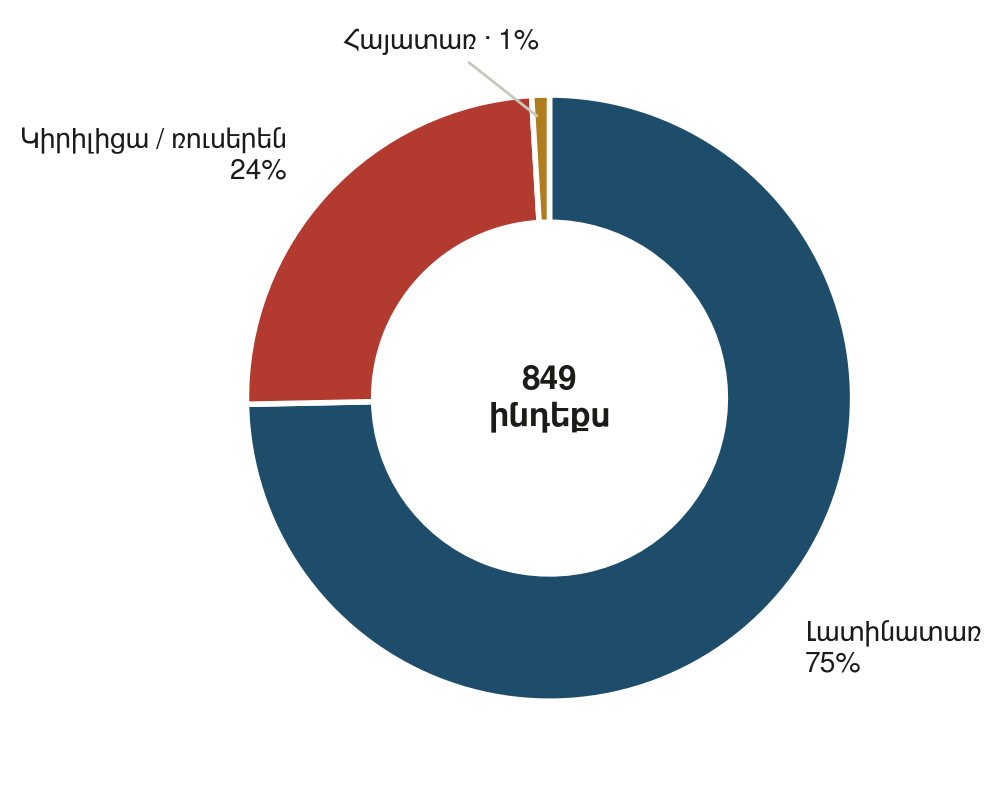
Search interest by language: weighted distribution of top queries by writing system. The “Latin-script” category is mixed.
Nearly three-quarters of the entire dataset is written in Latin script, but this figure can be misleading. It combines English words, global brands (such as YouTube), Armenian written in Latin characters, and websites using the .am domain. The clearest signals lie at the margins: around 24% of queries are in Cyrillic (Russian), while barely 1% are written in the Armenian script. Armenians overwhelmingly search in Russian, English, or Latin-script Armenian, and only rarely use Armenian letters.
The Fall of betting
One of the most interesting findings from the data is that, while betting brands account for a significant share of search traffic, they are simultaneously experiencing a steady decline. To avoid promoting these websites, we will refer to them simply as A, B, C, and so on. Brand A (55) ranks as the country’s third most searched query, followed by B (32), C (20), D (19), and E (13).
A −60% · B −60% · C −70% · D −50% · A-(Variant)−70%
High search volume coupled with a sharp decline most likely reflects the impact of the advertising ban on betting platforms, which appears to have reduced branded searches in particular. The decline is therefore likely driven by regulation rather than by a loss of public interest. It is also possible that users are simply accessing these or similar platforms through other means, since available data indicate that betting activity in Armenia remains substantial. Nevertheless, the downward trend is evident.
The AI Boom
If betting belongs to the category of declining searches, generative AI is firmly in the growth category. Interest is rising equally across English, Russian, and everyday transliterated spellings. Here, too, we see the Russian-language query «чат гпт» (Chat GPT) increasingly being entered independently by users in Cyrillic.
gemini +1350% · чат гпт +450% · chatgpt +300% · gpt +140%
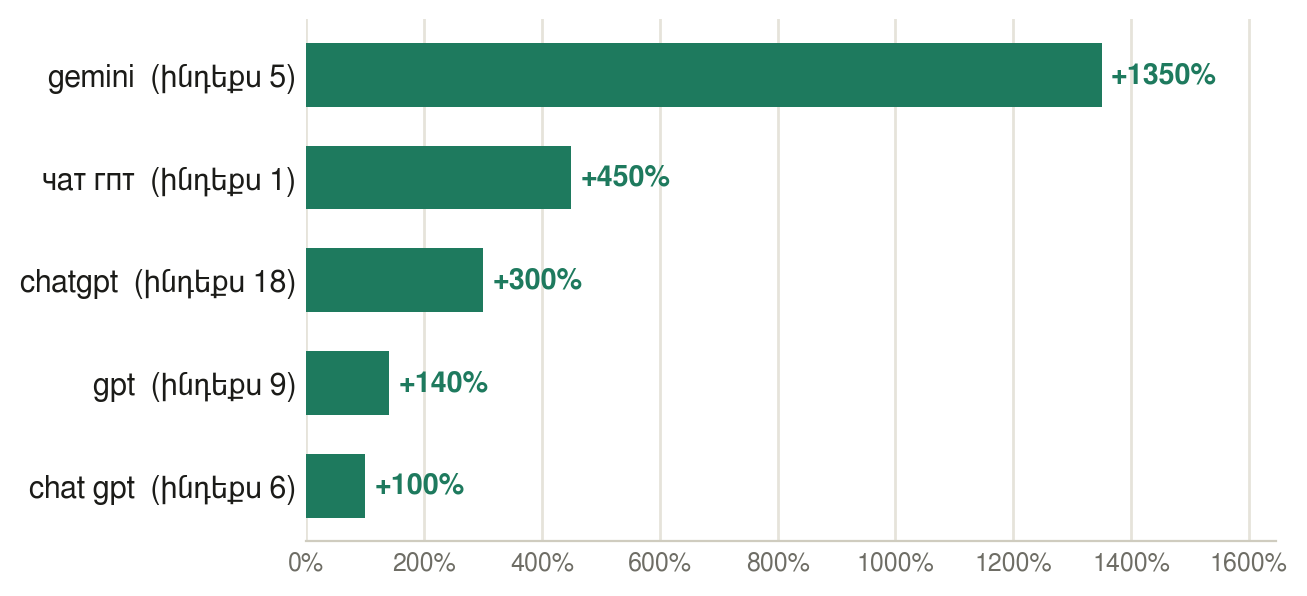
Growth in generative AI searches: Bars indicate growth compared with the previous period; figures in parentheses show search volume on a 0–100 index.
An important notice is that this rapid increase in interest is coming from a very low starting point. Currently, overall interest in AI is only about 39 index points, which is still a small fraction compared to searches for topics like betting (155) or weather (145+). Thus, the correct interpretation is not that “AI is the most searched topic”, but rather “AI represents the fastest-growing new search behaviour.” In essence, we are transitioning from nearly zero interest to more frequent usage. These impressive growth rates are based on relatively small search volumes; for instance, Gemini’s 1,350% increase corresponds to an index value of just 5.
E-commerce reordering
The retail landscape is also showing a clear shift. Chinese e-commerce platform Temu has doubled its presence in the rising searches, while Russian retail giant Wildberries has declined by half. Armenia’s local marketplace, List.am, is also losing ground. Of course, this is a very short a time frame to draw firm conclusions, but an emerging trend is already visible.
temu +100% · wildberries −60% · list.am −20%…−30%
Distancing from Russian Internet
Global platforms dominate the Armenian search space in absolute terms, with a total of 172 indexes (YouTube 58, Google 38, Facebook 19, Gmail 16, Telegram 13…) versus only 40 for Russian-origin platforms, a 4.3-fold difference. Moreover, all five major Russian-origin services are in decline, while several global platforms continue to gain ground.
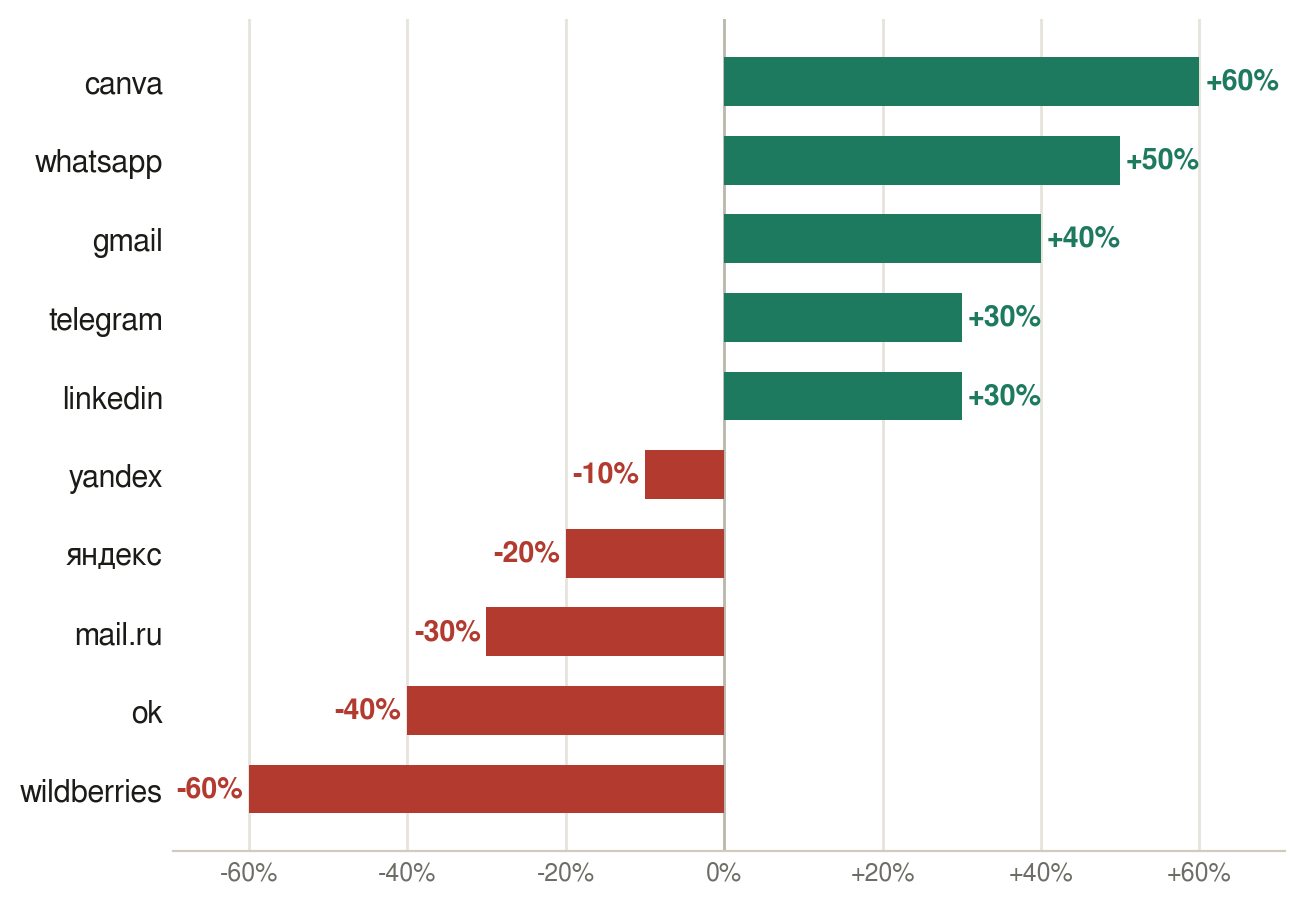
Digital migration: from Russian-origin platforms to global tools. Horizontal axis: change from the previous period.
The decline in interest in the once-dominant Mail.ru is striking. Just a few years ago, it was virtually the only major email service in Armenia. Interestingly, however, the migration is platform-based rather than language-based. Users are switching to Western platforms while continuing to search in Russian. As noted earlier, the Russian-language query “погода” (weather) remains the leading weather search, “переводчик” (translator) with an index of 48 outperforms the “English translate” (39), and “реал мадрид” appears alongside “Real Madrid”.
Hypothesis: chasing the news on Telegram
A few days after the elections, Armenia’s search trends are predominantly about the FIFA World Cup and betting. Yet even during the election campaign, search data showed little direct interest in politics. According to search engine trends, voters were not actively researching or comparing political options. Political interest is not reflected in Armenia’s search landscape through candidates’ names. No election-, party-, or candidate-related queries appear among either the most searched or the fastest-growing searches, a noteworthy finding by itself. Instead, political engagement appears through a shift in the information infrastructure. Traditional web-based news outlets are losing ground, while Telegram is steadily expanding its role.
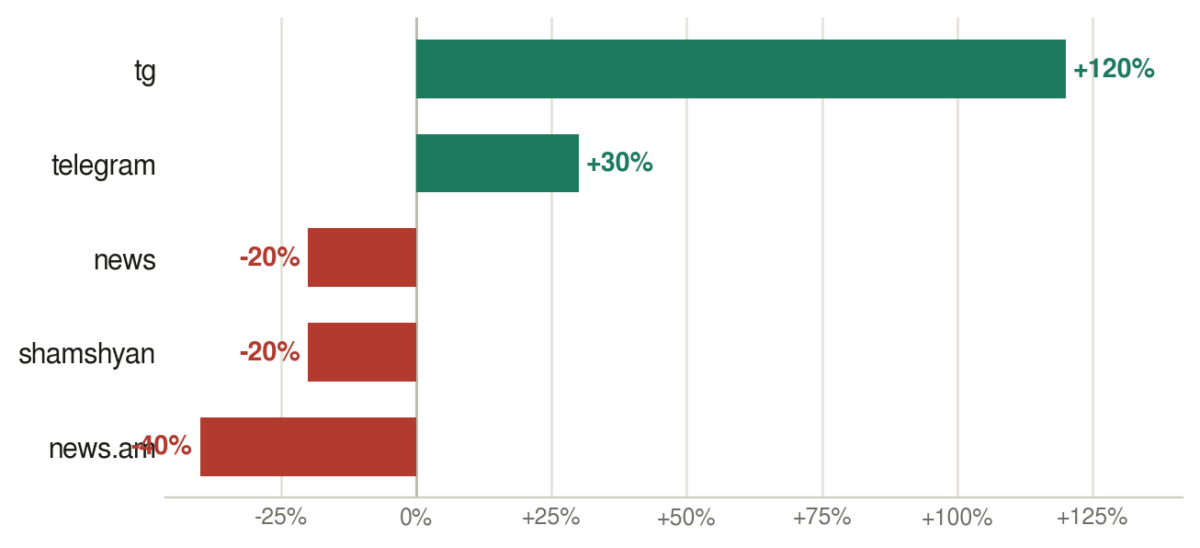
Traditional News outlets against Telegram
We accept the hypothesis that, in this context, Telegram should be viewed not merely as a messaging app, but as a convenient platform for consuming news. However, caution is warranted. The data show a decline in news-related searches alongside a rise in searches for Telegram, but they do not explain why people are using the platform. Even so, the direction of the trend is clear and fully consistent with the observation that election-related queries are virtually absent. In Armenia, people do not appear to seek political information through open search engines; instead, they increasingly consume it through closed, algorithmically unmoderated channels.
Civic Engagement: SRC, Taxes, and ARLIS
An entire category is rising simultaneously: searches related to government institutions.
ՊԵԿ +110% · tax service +80% · road police +50% · taxservice +50% · ARLIS +30%
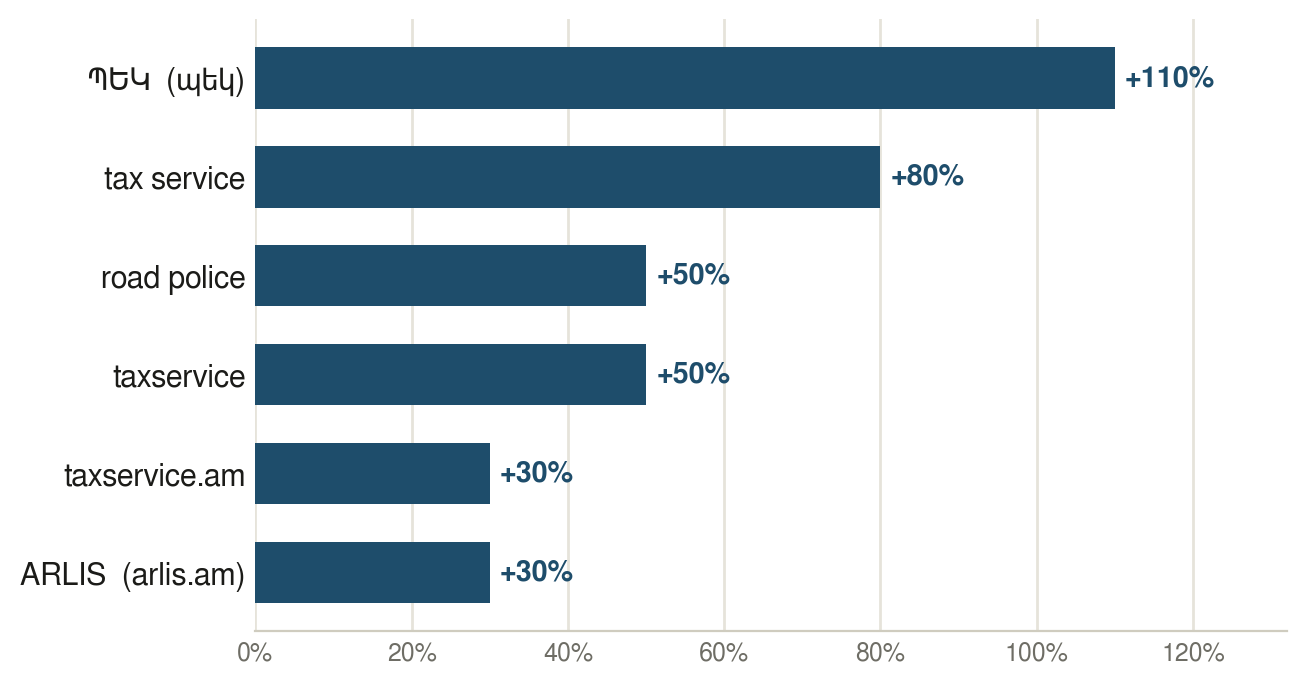
Rise in search for social services
This is most likely a consequence of the introduction of the universal income declaration system. It should, of course, be noted that people in Armenia also use other search engines. Nevertheless, Google remains the dominant platform, and its data are sufficiently representative to provide a reliable picture of overall search behaviour.