From the very beginning of 2026, Armenia’s public and political agenda began to take shape around pre-election topics.
During this time, YouTube and other social networks have evolved into platforms for complex, multi-layered political debates that can significantly influence public opinion. With this in mind, we studied the content on the platform as well as the comments associated with it.
This study focuses on the YouTube channels of several Armenian media outlets. We recognise that news content on these platforms is frequently accompanied by user reactions, which can enhance the reach and spread of the narratives being shared. Consequently, we also collected comments from viewers.
By analysing YouTube channels, we have identified the most-shared narratives, observed existing patterns, and examined whether comments influence the reproduction of the theses discussed in the videos .
How was the study conducted?
The study data was collected using the Disint.ai platform, which utilizes artificial intelligence (AI) to monitor trends and summarise patterns.
The study spanned from January to May 2026. Disint.ai was pre – configured with a list of 14 YouTube channels and a list of 15 political narratives
The program analyzed tens of thousands of hours of video content and their comments, identifying instances where the selected topics were mentioned or discussed.
The following channels were studied: AlphaNews, 24TV, 168.am, News.am, Euromedia24, h2, Kentron TV, Hayeli.am, Hraparak, Antifake, ArmeniaToday, Oragir, Aravot, NewDay.
During four months, the following narratives and the dynamics of their use were monitored.
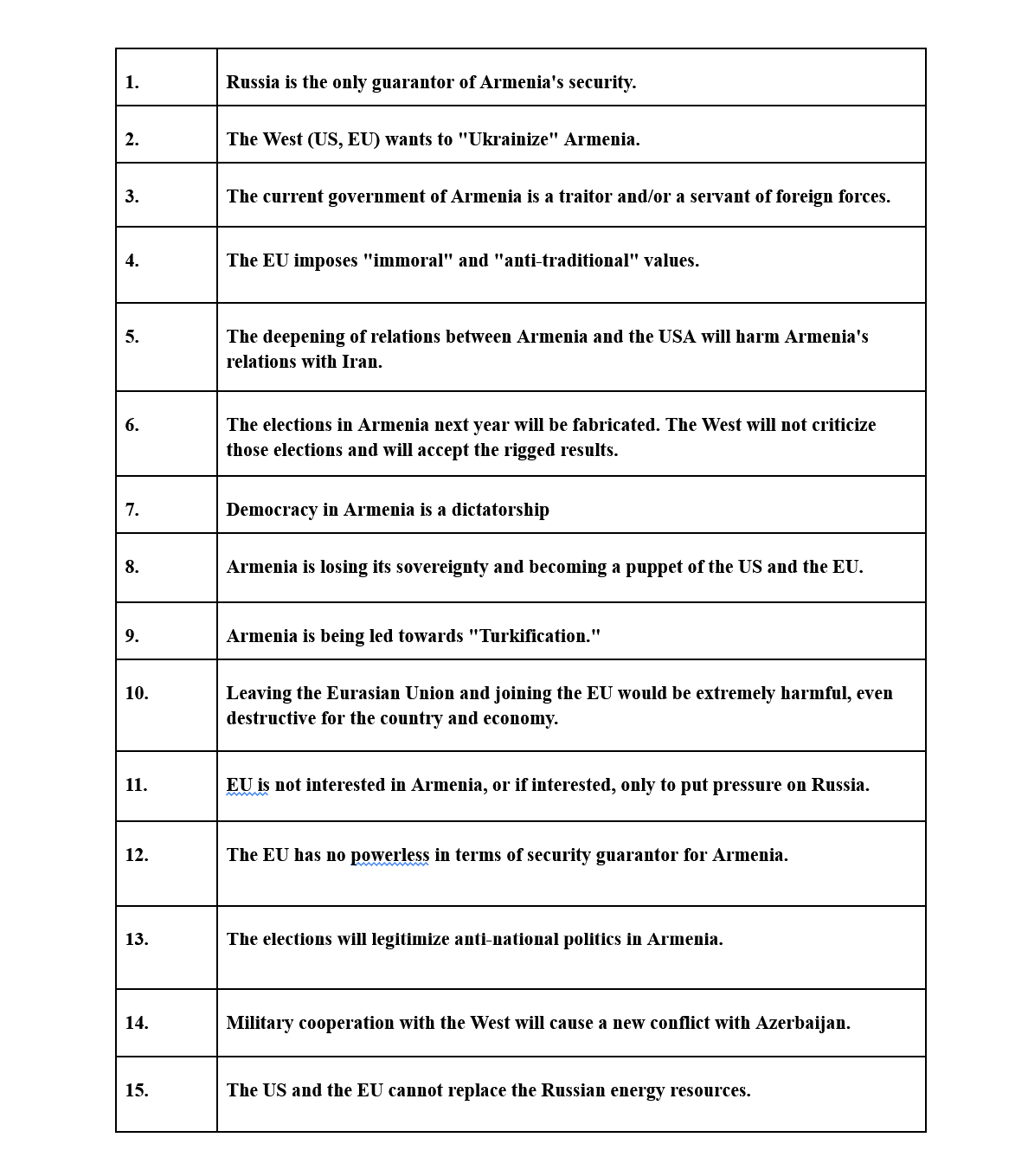
The list of selected narratives
This article summarizes data collected on Disint.ai as of May 4.
What was unveiled
Out of the 15 main themes, 13 were identified in videos and comments.
The relevant theses were mentioned a total of 2,774 times in the videos from the selected channels.
There were 83,300 comments recorded, with 13,300 of these comments repeating or discussing these narratives. Additionally, 4,500 users wrote comments that included these theses.
Monitoring the YouTube domain helps us understand the narratives shaping information flow. The data indicates that discussions focus on a few key topics, that make up most of the content.
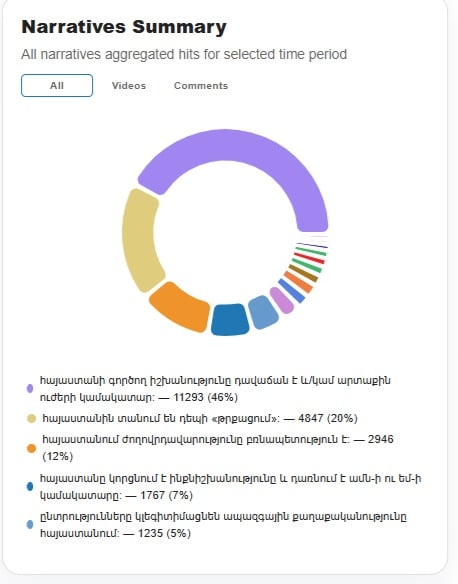
The most common narrative revolves around the independence and legitimacy of the current government. In nearly half of the cases (46%, or 11,293 instances), the claim is made that the current administration serves foreign interests or betrays the nation’s interests. This sentiment is expressed as follows: “The current government of Armenia is a traitor and/or a servant of foreign forces.”
Alongside these issues, concerns about security and identity are major in the information field. In 20% of the analysed content (4,847), the concept of “Turkification” is prevalent.
The third direction that completes this picture is the perception of democracy. In 12% of cases (2946), the claim that democracy in Armenia is essentially a dictatorship is documented.
The dynamics
The first three months of 2026 were relatively stable in the Armenian YouTube domain. Monitoring reports indicated that videos were being published at a regular frequency, and political narratives received between 200 and 250 mentions per day.
However, after April 1, the situation changed dramatically. Artificial intelligence detected a phenomenon that can be described as an “information explosion.”
The number of selected narratives, which had previously remained stable, increased significantly on April 4, surpassing 800 per day. This surge indicates a substantial rise in the number of political theses in the content over a matter of days. Audience engagement also increased dramatically during this period, with comments reaching approximately 350. Although the situation calmed somewhat by mid-April, another surge was observed from April 25 to May 1, when the number of narratives once again exceeded 500.
It can be concluded that April 2026 was a period of highly coordinated and focused information attacks, during which YouTube channels and comment streams united around a single political agenda.
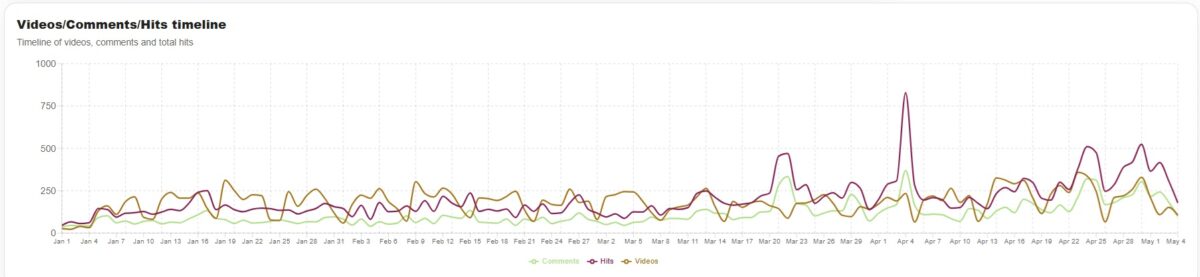
The dynamics of the narratives in the videos and comments (green – comments, orange – videos, purple – number of mentions in narratives)
Among the analysed YouTube channels, hayeli.am had the highest frequency of narrative use, with 1,595 mentions of targeted narratives. A notable narrative that emerged was the depiction of the government as either a “traitor” or a “servant of foreign forces,” which was used 698 times.
Hayeli.am is closely followed by 168.am, with 1,326 mentions. On this platform, the theme of “betrayal” appears prominently with 487 mentions, while the narrative that “Democracy in Armenia is actually a dictatorship” also holds significant visibility, with 251 mentions.
In the case of 24TV, there were 801 recorded mentions. As in previous channels, the dominant narrative here is that of the government being a “traitor/servant”, which aims to undermine the government’s legitimacy (305 mentions).
News.am, with the largest audience, recorded 635 mentions. Nearly half of these (288) relate to themes of government “betrayal” or external dependence. However, despite its extensive reach, News.am falls behind Hayeli.am and 168.am in the overall volume of such narratives. This indicates that the prevalence of these themes is lower on News.am compared to the other platforms.
AlphaNews rounds out the top five with 457 mentions. The main narratives on this channel, both in broadcasts and in commentary, focus on “betrayal” (152 mentions) and “Turkification” (76 mentions).
The dynamics of narrative spread in the Armenian YouTube domain illustrate a clear mechanism of thematic amplification, in which core political theses expand through audience engagement.
Our analysis indicates that the narrative of “betrayal by authorities and serving foreign forces” is central on YouTube. This narrative has the highest engagement both in the videos’ content and in the comments. A substantial number of comments surrounding this narrative have amplified it, resulting in approximately 2,600 mentions. This number reflects the audience’s strong cohesion around these key themes.
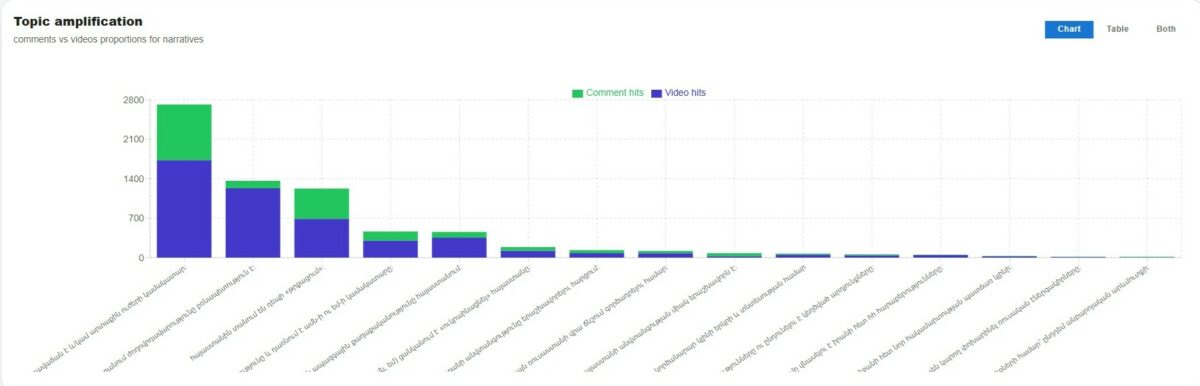
Intensification of narratives (blue: narratives in videos, green: narratives in comments)
The concepts of “Turkification of Armenia” and “Establishment of dictatorship under the guise of democracy” warrant special attention. Although these ideas are only briefly mentioned in the videos, they gain prominence in the comments section. Specifically, regarding the “Turkification” thesis, the volume of comments closely matches the substantive mentions in the videos, amplifying the sense of public alarm. This situation illustrates how both media content and user reactions have collectively contributed to the dissemination of the same political ideas.
Most mentioned political players
The representation of the “main characters” in the Armenian YouTube domain during 2026 is noteworthy. Monitoring by the Disint.ai platform indicates that information flows are organised around a highly personalised targeting principle.
The main figure in the discussions is the Prime Minister of Armenia, Nikol Pashinyan, whose name was mentioned approximately 6,500 times. This highlights that the central focus of the political narratives revolves around the current Prime Minister, with mentions significantly exceeding those of all other political figures.
The leader of the “Strong Armenia” party, Samvel Karapetyan (1600), and the President of Azerbaijan, Ilham Aliyev (1100), are notably active on this list. This suggests that the domestic agenda is closely linked to external factors. Additionally, the significant presence of U.S. President Donald Trump and Russian President Vladimir Putin indicates that the topics being discussed have a broad geopolitical scope.
In terms of geographical mentions, Armenia was referenced a record 15,400 times. The significant impact of external factors in political discussions is evident: the countries mentioned after Armenia are Turkey (4,600 mentions) and Azerbaijan (4,400). Additionally, Russia and the United States are also among the most frequently mentioned.
It can be concluded that this information attack is coordinated and has clearly defined targets, focusing on one individual and key security directions.
User comments
An analysis conducted using artificial intelligence has identified a group of users who are the most active responders to YouTube videos.
Topping this list is the user @Ara-x9s, who, in just 82 days, left 323 comments across 8 channels. The system has flagged them as a “bot” due to their repetitive use of “copy-paste” comments and a consistent pattern of quick, network-driven behaviour. This user posted identical comments multiple times across various videos within seconds.
Close behind is @KarineHovhannisyan-b2s, with a total of 271 comments and engagement across 13 channels. Both of these users have also accumulated an impressive number of likes, exceeding 800 to 1,000, which suggests that their engagement may be artificially generated.
The claims made by these users are significant. They consistently promote similar narratives, such as “the government is a traitor,” “Armenia is being led toward Turkification,” and “democracy is a dictatorship.” For instance, the first two users alone repeated the “treason” narrative in their comments over 440 times.
It can be concluded that this opinion is insincere and part of an organised effort. These users act as information “multipliers,” promoting the necessary political agenda under each video.
Monitoring of the YouTube domain during the first five months of 2026 revealed a significant spread of organised political narratives, with a notable increase in mentions occurring in April. The study indicates that the content predominantly targets the government’s legitimacy, suggesting it serves as a proxy for foreign forces and raising security concerns. Data analysis also uncovered users in the comments section exhibiting artificial behaviour, enhancing the visibility of their viewpoints by repeatedly posting similar texts.
The analysis using Disint.ai is currently ongoing. Future studies will focus on various groups of YouTube channels and their narratives.
All images used in the article were created by the Disint.ai platform.