War coverage often starts with statistics: the number of victims, displaced individuals, and cities reduced to ruins. These statistics represent more than just numbers; they tell the stories of real people experiencing uncertainty, fear, and incomplete truths. Journalists who attempt to share these narratives often find themselves in a similar situation, dealing with limited information, conflicting sources, emotional challenges, and ethical dilemmas in their profession.
How can we report on a reality that is fragmented? What does it mean to be a journalist who not only reports on war but also experiences it firsthand?
During the panel discussion titled “Right Now, on the Front Line” at “Tvapatum: Aftershock 2026” in Yerevan, participants tried to address and answer these questions based on their personal experiences. They shared examples from Iran and Ukraine to illustrate how the media functions in times of war and crisis.
Pooneh Ghoddoosi – head of Global Partnerships, BBC; presentor, editor, Great Britain
Imagine a situation where you are a journalist covering a war. It is already difficult, dangerous, and psychologically demanding, but you are ready for it. It is your profession.
Now imagine that you are covering a war in your own country, and everything changes. You are no longer reporting on events; you are speaking about your city, your school, your home, your memories. And suddenly, you find yourself in a situation where not only is information limited, but you are cut off from that reality yourself. That is exactly the kind of journalist I am. I am from Iran, but for nearly 20 years, I have not been allowed to return. I cover my country without the right to be there.
You try to understand what is really happening when the information you get is fragmented and often contradictory. You try to feel people’s moods, understand their pain, their fears, their hopes, without the opportunity to talk to them freely. Because if they send you material, they can be arrested. If you try to talk to officials, they simply won’t talk to you. You are left with almost no tools to verify the truth.
In the meantime, you get stuck in the swamp of trauma, threats, and heavy emotions.

Pooneh Ghoddoosi
At the same time, you see how differently people perceive the same war. Some people are literally under bombardment, but they say this is salvation, this is liberation, and they thank the outside forces. Others see it as an illegal, cynical war for the interests of the great powers. And there is a third group: people who hate their regime, but hate foreign intervention just as much because they don’t want to see their country destroyed.
And you, the journalist, are standing amid all these stories, without access, without full facts, but with a huge responsibility.
At the same time, you are facing pressure from all directions. Authorities are persecuting you, while the opposition claims you are not being harsh enough. Others are pushing you to take a side. People have unreasonable expectations: they want you to be quick, precise, first, and flawless all at once. When you stumble, they criticize you, and sometimes they even resort to threats.
I’ve experienced it firsthand. My assets have been frozen in Iran. I’m not allowed to return. My family has been interrogated. My colleagues have received death threats. And you understand, this is not just a profession. This is a choice that you pay for.
But here comes the most important question: why are you doing this?
I realized that, first and foremost, I need to be honest with myself. I must understand clearly who I am, where I stand, and what values I uphold. Then, I need to be equally honest with my audience. I should communicate not only what I know but also what I don’t know, what I can’t verify, and what I’m not allowed to say.
In reality, a journalist’s job involves more than just conveying information; it also requires recognizing one’s own boundaries.
I often think of it this way: We all have an internal “backpack” filled with our beliefs, traumas, political views, and memories. When we go to work, it’s important to try to leave that backpack at the door, or at least make the effort.
It’s not an easy task, and it rarely goes perfectly. However, journalism cannot exist otherwise.
Another difficult truth is that, no matter what actions you take, there will always be people who feel dissatisfied. Half of them will claim you shared too much information, while the other half will argue you revealed too little.
One day, I found myself reflecting that if both sides were unhappy with my work, perhaps that was a sign I was on the right track.
However, everything becomes even more difficult when it involves your own country. You are not just an observer; you are part of the story. It’s not only your career that’s at risk, but also your life and the well-being of your family.
And yet, every morning, we wake up and face the day again.
Ultimately, it all boils down to one simple yet challenging question: What do you stand for?
If you can answer that question, you’ll find the strength to keep going. If you can’t, this job may break you.
Ruslana Brianska, Executive Director of Hromadske Radio, Ukraine
We began our broadcasts on Hromadske Radio in 2016, a time when tensions were already high in Ukraine. This was the period of the revolution when people took to the streets to defend their right to be heard, and journalism was under significant pressure. Censorship was a real threat, and during this critical moment, we chose to embark on our journey as an independent radio station.
On the first day of Russia’s full-scale invasion in 2022, we lost several of our transmitters. However, that same day, we managed to inform the people of Mariupol that the war had begun. Sometimes, a single sentence can change lives.
Currently, around 600,000 people listen to us each week, and millions tune in online throughout the month. However, our focus is not solely on numbers; the most important aspect for us is trust. We value our connection with our audience, especially those living in occupied territories, where Russian propaganda is prevalent and independent information is limited.
At times, that connection feels insignificant, just a radio channel.
However, it is actually a lifeline. One of our co-founders spent over two years in a Russian prison, and interestingly, he listened to our radio station during that time. Even the guards tuned in. When he returned to Kyiv, he remarked, “If Hromadske Radio exists, then Ukraine exists.”
That was the moment I realised we are not just a media outlet; we are proof that the country is still standing.
There is another story from when the city was occupied: people had no electricity, no internet, and no television. Their connection to the outside world was severed. All that remained was a battery-powered radio, and people listened to us.
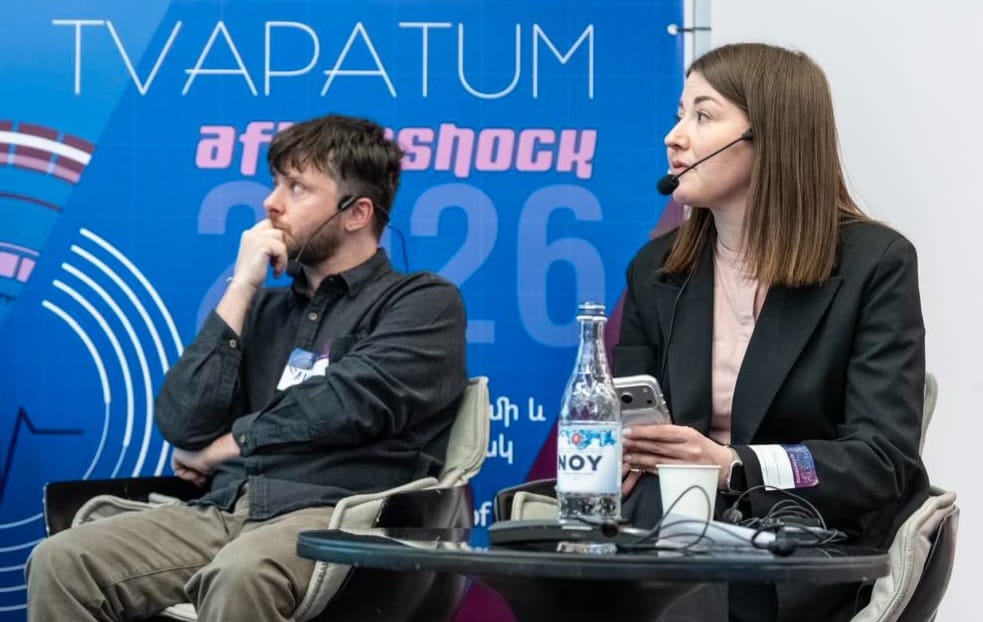
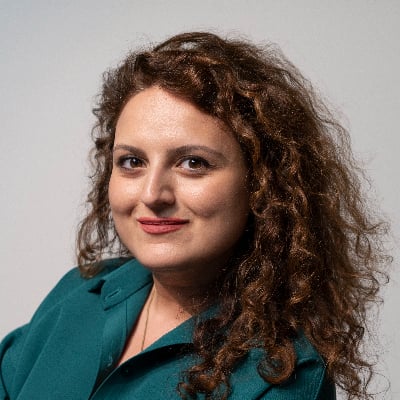
On the right, Rusulana Brianska
A man later wrote a book about those days, and he titled a chapter: “If you heard the radio in an occupied city, it meant your own people were nearby.”
I have experienced this myself. I am from Bucha. When I returned, my neighbors told me, “We had nothing: no water, no electricity, no communication. But we had the radio, and we heard your voice.”
That was the moment I realized that journalism can sometimes be just a voice, reminding people that they are not forgotten. However, everything has a price.
Some of my colleagues work directly on the front lines. One team member was killed in a Russian prison. He wrote for us a few years ago and produced excellent work.
Today, he is gone. War is not just the story we tell; it is also about the lives we lose.
There are other difficulties, too. Last year, we encountered a financial crisis that led us to cut back on programs and close departments. Despite these setbacks, we continued to work hard.
In winter, we worked without electricity. There was no light in the studio or in the houses. However, we would turn on the equipment and continue broadcasting, because we knew someone was waiting for that sound.
I often get asked why I keep going, why I continue my work amidst missiles, danger, and uncertainty. The answer is simple:
We serve as a vital link between people. Our radio not only keeps listeners informed but also helps them learn, understand, and stay connected to their country, even when they’re far away or isolated.
I truly believe that one day we will share stories not of war, but of victory.
On that day, our voice will still be present, just a bit quieter.