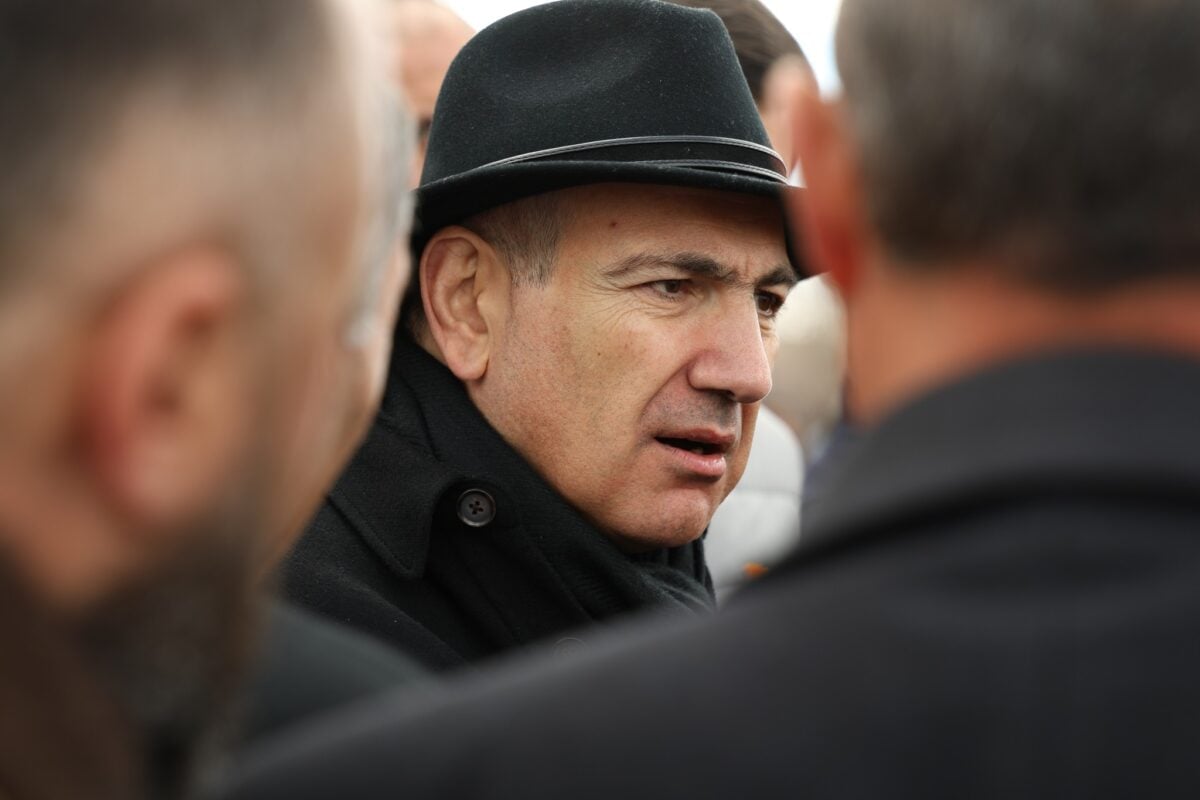
On March 22, Deutsche Welle’s Russian service commented on the incident involving the Armenian Prime Minister Nikol Pashinyan and a displaced Artsakh woman in the Yerevan metro.
“Pashinyan argued with a woman in the metro over Karabakh. On March 22, the Armenian prime minister was walking in the Yerevan metro with his team when one of the passengers recognized him and accused him of handing over Nagorno-Karabakh to Azerbaijan,” the German outlet wrote, citing NEWS.am.
The report also notes that Pashinyan later apologized, saying he “could not contain his emotions when the conversation shifted to Nagorno-Karabakh.”
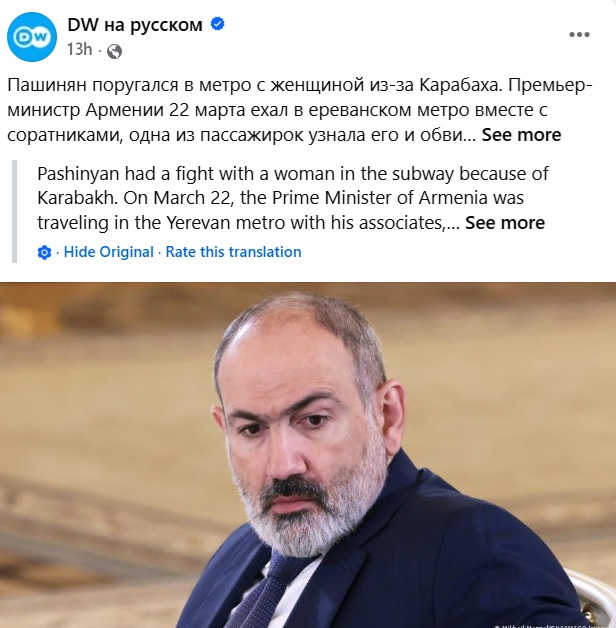
Verified reviewed the video of the incident and found that the German agency misrepresented the details of the argument. The displaced woman from Artsakh did not accuse Pashinyan of handing over Karabakh to Azerbaijan.
We were unable to find such wording on NEWS.am. No such phrasing appears in either the Armenian or Russian versions of the outlet’s coverage. The Armenian version reads: “Prime Minister Nikol Pashinyan, who was walking with his teammates in Yerevan today, once again lost his composure when asked about the Armenian exodus from Artsakh.”
What happened during and after the incident
During the incident, the Prime Minister attempted to present a map to a woman from Artsakh and her child. However, the woman declined, saying that they already had another map and requested not to be disturbed. Despite her refusal, Nikol Pashinyan continued the conversation, remarking, “Your son will live on this map.”
In response, Armine Mosiyan, a displaced woman from Artsakh, said, “Will you not allow us to live in our Artsakh? You cannot take away our hope of living there.”
She reiterated her request not to continue the conversation, emphasizing that the only reason they had not gotten off the wagon was that they were running late.
Nevertheless, Pashinyan continued, saying that the conversation did not hinder the train’s motion. “We have done everything to ensure that you can live in Artsakh, in Karabakh. In 2023, you accused me of closing the borders to prevent people from coming from Karabakh to Armenia. You demanded that I open the borders, claiming they had been deliberately closed to keep people from leaving Karabakh. Now that you are here, you say you want to return. We have spent billions, earned by the citizens of Armenia, so that you could stay there; so why didn’t you stay? Next time, don’t try to claim, having fled, that I gave away Karabakh,” Pashinyan remarked.
During the argument, Armine Mosiyan asked Prime Minister Pashinyan not to raise his voice or speak to her with a “wagging finger.” In response, Pashinyan stated, “I will speak to you like this.”
What happened after the incident
After the incident, Pashinyan denied having called Mosiyan a “fugitive.”
“It is impossible that I said such a thing; I could not have said that. If it was perceived that way, it was a misperception. If I said something improper, I am sorry,” Pashinyan said.
Following the incident, Human Rights Defender Anahit Manasyan released a statement emphasizing the importance of handling communication with forcibly displaced persons and refugees with due sensitivity. The statement read: “Communication with forcibly displaced persons and refugees, as well as discussions of issues related to their rights, must be conducted with due sensitivity, taking into account the vulnerability of these groups. This is required by the applicable international legal standards in the field.”
At the end of the day, Nikol Pashinyan apologized to Armine Mosiyan and her child and invited them to a meeting. He acknowledged, “I still find it difficult to reflect on the events of 2023 without strong emotions, and I recognize that this is a significant flaw. I accept this flaw and realize I cannot move past that moment.” Pashinyan promised to thoroughly reflect on the events of 2023 in the future.
Deutsche Welle’s wrong retelling
Contrary to the German agency’s assertion, the citizen did not initiate the conversation with the Armenian Prime Minister, nor did she accuse Pashinyan of surrendering Karabakh to Azerbaijan.
Moreover, Deutsche Welle’s claim that Pashinyan said he could not contain his emotions when speaking about Nagorno-Karabakh is also misleading. In fact, he was referring not to Nagorno-Karabakh in general, but specifically to the events of 2023, when Armenians in Nagorno-Karabakh were forced to leave their homes following the military operations initiated by Azerbaijan.