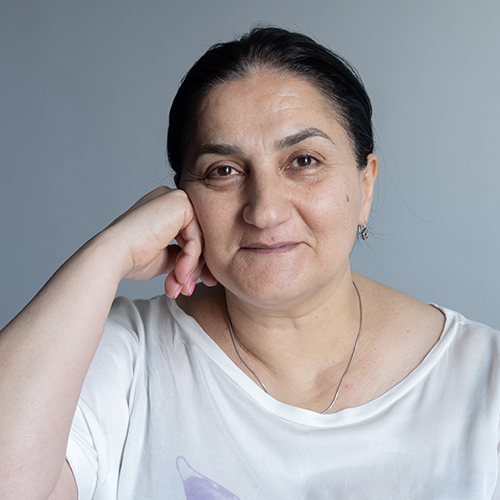
During a press conference on March 12, Prime Minister Nikol Pashinyan made yet another controversial statement, this time, regarding Edita Gzoyan, the Director of the Armenian Genocide Museum-Institute. He stated that he had given instructions for her dismissal. However, it’s important to clarify that the Prime Minister does not have the authority to appoint or dismiss the director; these decisions are made by the board of trustees. Nevertheless, he does approve the members of that board.
At the urging of Nikol Pashinyan, the chairman of the Supreme Judicial Council was dismissed from his position. In Ijevan, he also directed that the daughter of a citizen who had reached out to him not be appointed as the kindergarten director. In this context, the Prime Minister’s instruction to dismiss the museum director was not unprecedented. However, what stood out were the reasons and justifications behind that decision.
At the press conference, the Prime Minister stated: “Yes, I considered it a provocative action that contradicts the foreign policy pursued by the government, and I asked that a resignation letter be submitted. When the country’s prime minister says there is no Karabakh movement, what does it mean to present a foreign guest with a book on the ‘Artsakh issue’? How many people in this country can conduct foreign policy? Armenia’s foreign policy is conducted by the Armenian government, and any state official who says anything that contradicts it must be dismissed. What is there to discuss here? Are we a state or an amateur group?”
In 2025, the Prime Minister stated that the Karabakh movement should not continue, but he did not clarify what this meant. He failed to specify which actions or events could constitute a continuation of the movement, nor did he outline how such actions might manifest, or explicitly say what should be avoided. What the Karabakh movement encompassed is clear: it included the Karabakh Committee, demonstrations in Freedom Square, the Artsakh war, and the Republic of Artsakh. Of these, only Freedom Square remains today. Given that Artsakh no longer exists, it is difficult to define what constitutes a continuation of the Karabakh movement.
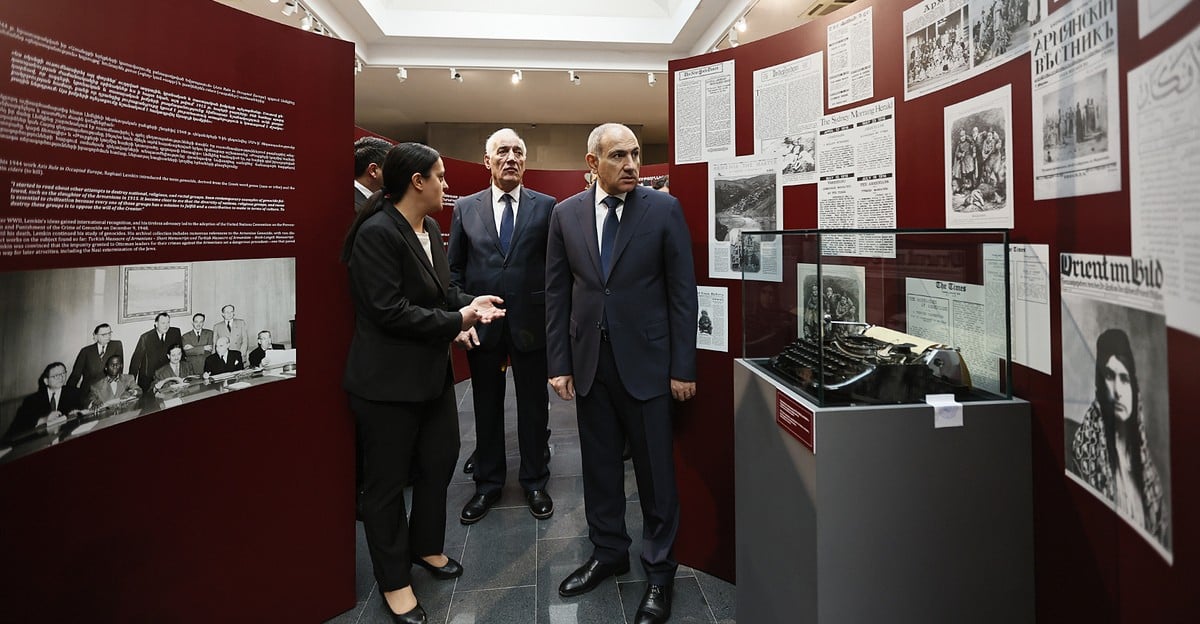
When presenting a book to J.D. Vance during his visit to the Tsitsernakaberd Memorial Complex, Edita Gzoyan could hardly have assumed that this gesture would be interpreted as an attempt to conduct foreign policy or to continue the Karabakh movement. Vance is certainly not the only visitor to Tsitsernakaberd who has been gifted a book. The title of the book has not been clearly specified: the Prime Minister said it concerned the Artsakh issue; Edmon Marukyan stated it was a collection of articles by American journalists on Armenian–Azerbaijani clashes; meanwhile, the press reports that the books were about the genocide and Artsakh.
Gegham Manukyan, an MP from the Armenian Alliance, has expressed concern that dismissing an official for presenting a book about Artsakh could set a precedent for banning academic research on Artsakh in universities. In an interview with Factor.am, he stated that Prime Minister Pashinyan’s public remarks about firing the director were intended to send a message to Azerbaijan, demonstrating that he is effectively fulfilling his responsibilities and will not tolerate any discussion of Artsakh.
Maria Karapetyan, a member of the Civil Contrafaction faction, recalls that Serzh Sargsyan was trying to establish relations with the Turkish president while the Armenian Revolutionary Federation (ARF) was demonstrating. “This created a situation where we were making one statement at the official level while conveying a different message at another level. Gzoyan’s gift could have been interpreted as a sign that our country has not abandoned the idea of the Karabakh movement.”To avoid such situations, the Civil Contract MP asks all state employees to ensure their expressed ideas align with our foreign policy.
Another MP from the ruling Civil Contract faction, National Assembly Deputy Speaker Ruben Rubinyan, said on CivilNet.am that the law stipulates the Genocide Museum is part of the state protocol, where official guests of the country are received. “Therefore, presenting a book there about the Karabakh issue contradicts state policy.”
The Tsitsernakaberd Memorial Complex, dedicated to the victims of the 1915 Armenian Genocide, also features khachkars and monuments commemorating the victims of the Sumgait events and the Karabakh movement. Maria Karapetyan says, “When accompanying guests, I urge the tour guide not to stop at these sites or speak about them unless the guests specifically ask.” Ruben Rubinyan likewise finds it questionable that a visitor to the Genocide Memorial Complex is presented with a book about Artsakh.
After deciding to renounce the Karabakh movement and announcing it, does the government know how to carry it out? For instance, did they think that Gzoyan could present Vance with a book about Artsakh? Did they consider it necessary to discuss this with her and inform her that the director and the museum are now part of the government’s new foreign policy? The CC deputies do not provide clear answers to these questions. A reporter from Factor.am attempted to gather more details on the topic by calling the State Protocol Service, but was unable to speak with the head, who was busy.
The official website of the Armenian Genocide Museum-Institute opens with an image of Mount Ararat. If the museum is considered part of foreign policy, and the government has decided to distance itself from the image of Ararat. Hrachya Tashchyan, the museum’s acting director, may want to reconsider its use. Tashchyan previously served as an assistant to Nikol Pashinyan on foreign policy and as head of the government’s foreign relations department.