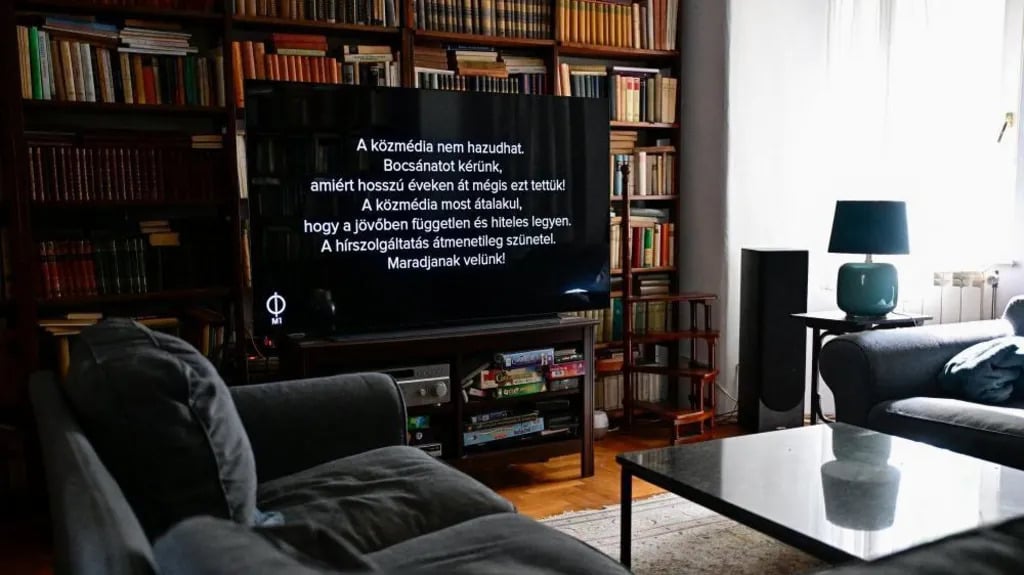
One July morning, viewers tuning into Hungary’s state broadcaster M1 were met not with the news but with a black screen.
A simple message appeared: “Public media must not lie. We are sorry for doing it for so long.”
After sixteen years of Viktor Orbán’s rule, it was one of the most arresting images in recent European politics. For the first time, Hungary’s public broadcaster openly acknowledged what journalists, watchdogs and international observers had long documented: it had ceased to function as an independent public service and had become an instrument of political power.
The apology was powerful. But it also raised a more uncomfortable question: can the media truly become free simply because the government has changed?
Hungary is now attempting to answer that question. Yet the dilemma extends far beyond Budapest. Every democracy that emerges from authoritarian rule, democratic backsliding or deep political polarisation eventually confronts the same challenge: dismantling media capture is far harder than replacing the politicians who benefited from it.
Media capture has evolved
Twenty-first century autocrats rarely need to imprison journalists or close newspapers outright. Those methods are costly and internationally conspicuous. Modern media capture is far more sophisticated.
Governments channel public advertising towards politically loyal outlets. Business allies acquire television channels and news websites. Public broadcasters gradually become government broadcasters. Independent journalists are buried under strategic lawsuits, denied access to public information or subjected to relentless smear campaigns.
Control no longer depends primarily on censorship. It rests on financial dependence, regulatory pressure, political appointments and carefully engineered ownership structures.
Hungary is one of the clearest examples, but it is hardly unique. Similar patterns have emerged, in different forms, across Russia, Serbia, Turkey, Georgia and elsewhere.
The hardest reforms begin after political change
The real test starts when a new government inherits that machinery.
If a public broadcaster already serves political interests, regulators are politically appointed and state advertising can reward friendly media, why wouldn’t a democratic government be tempted to use exactly the same tools — albeit for what it believes are better purposes?
The temptation is less ideological than institutional. Replacing people is easier than rewriting the rules.
That distinction lies at the heart of the Committee to Protect Journalists’ assessment of Hungary’s first reforms under the new government.
It welcomes important early steps: restoring journalists’ access to public institutions, beginning to restructure public media, dismantling one of the bodies previously used to intimidate independent journalists and pledging to align Hungary’s media system with European standards.
Yet CPJ also issues an important warning. Personnel changes alone are not reform. Unless governments create institutional safeguards that protect editorial independence regardless of who wins the next election, today’s reforms may simply become tomorrow’s instruments of political control.
The objective is not merely to remove one government’s influence over the media.
It is to ensure that no future government can exercise the same influence again.
Changing the owner is not changing the system
This is where the line between democratic reform and political revenge becomes clear.
If a propaganda machine merely changes operators, the system itself remains intact. Only its beneficiary has changed.
Real reform looks different. It changes how public broadcasters are governed, how regulators are appointed, how state advertising is allocated, how media ownership is disclosed and how editorial independence is legally protected.
The goal is not to trust better politicians.
It is to build institutions that make abuse of power significantly harder, whoever happens to be in office.
A lesson that reaches far beyond Hungary
This is not simply Hungary’s challenge. Across many transitional democracies, political change is often followed by the same debate: should the leadership of the public broadcaster be replaced? Should the media regulator be reshuffled?
Far less attention is paid to the more important question: what needs to change so that the same argument does not return after the next election?
As long as public debate focuses on individuals rather than institutions, the cycle will continue.
A public broadcaster is not independent because the “right” people happen to run it today. It is independent only if, after the next change of government, the same newsroom is able to continue doing its job without political interference.
Removing an autocrat is only the beginning. The real challenge is building a media system that no government can capture again.
Hungary’s black screen was an extraordinary symbol. But symbols alone do not dismantle propaganda. “The factory of lies” is not truly closed while it can simply reopen under different management.