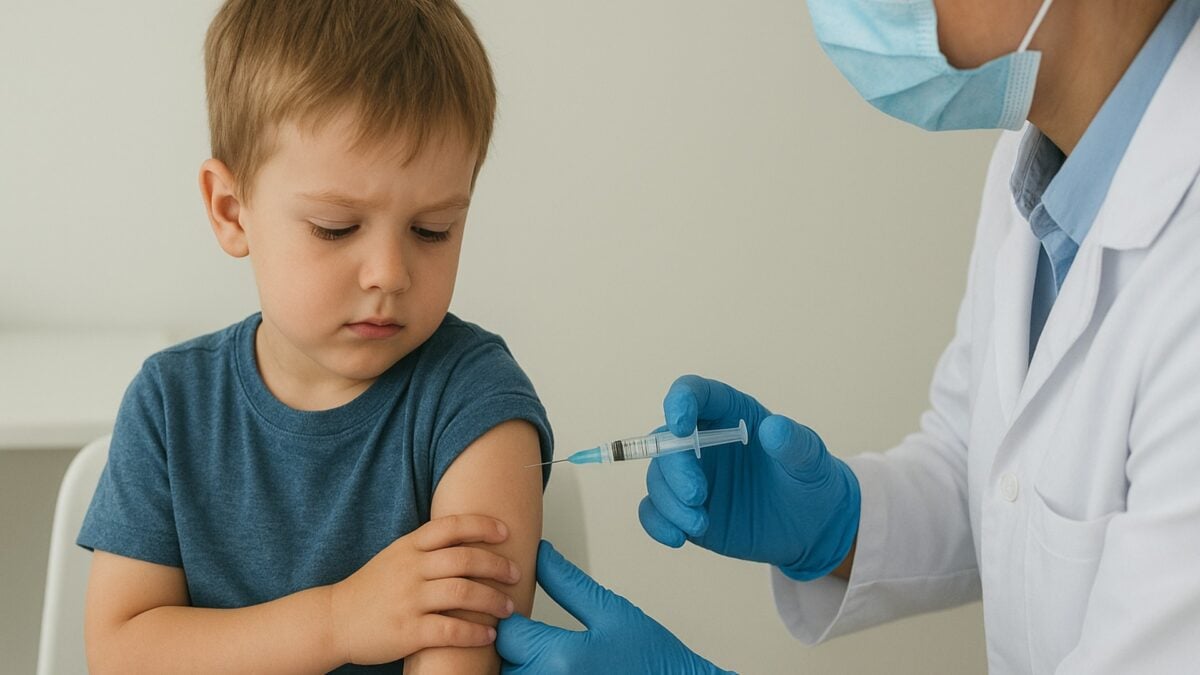
On November 20, Facebook user Nek Grigoryan wrote that the US Centers for Disease Control and Prevention (CDC) is officially revising its stance regarding vaccines and autism. He mentioned that the CDC serves as a global authority on health policy.
If the official website previously stated, “Studies show that vaccines do not cause autism,” the statement has now changed significantly. It now reads, “The claim that ‘vaccines do not cause autism’ is not evidence-based, as studies have not ruled out the possibility that infant vaccines could cause autism,” he wrote.
Currently, the post has over 100 comments and 136 shares. The user also shared it on his Instagram page. Additionally, the post was shared by former Yerevan Council member and well-known anti-vaccine activist Marina Khachatryan.
“Verified” found that Grigoryan’s claims are partially misleading. While it is true that the US Centers for Disease Control and Prevention (CDC) has adjusted its language on the relationship between autism and vaccinations, it is essential to note that the CDC is not a global health policy-making organization. Furthermore, there is no evidence supporting a causal link between autism and vaccines.
CDC revision
On November 19, the CDC’s official website updated its page on autism and vaccines. The revised text notes that the earlier statement that vaccines do not cause autism was not evidence-based.
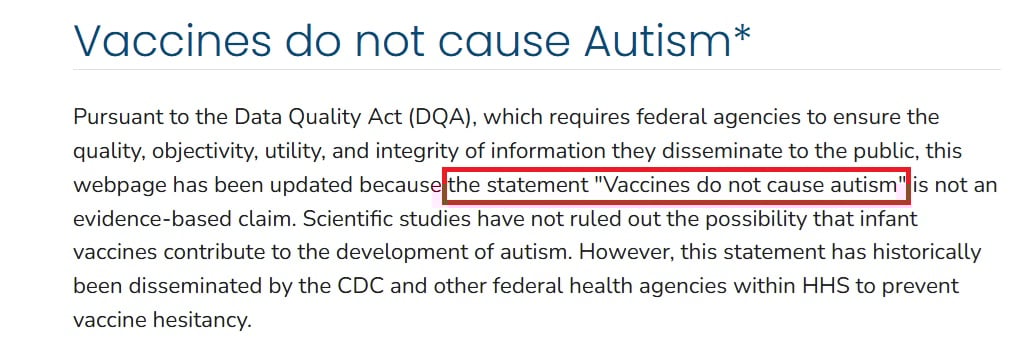
Screenshot: cdc.gov
The CDC highlights that scientific studies have not ruled out the possibility that childhood vaccines may play a role in the development of autism. Additionally, they note that previous studies have methodological limitations, and findings from research conducted in other countries may not align with those from the U.S. population. As a result, the organization emphasises the need for new, high-quality research in this field.
The headline of the post reads, “Vaccines Do Not Cause Autism*,” but it is important to note that an asterisk has been added to the title. The footnote explains that the title “Vaccines Do Not Cause Autism” was retained because the chairman of the U.S. Senate Committee on Health, Education, Labor, and Pensions agreed upon it; this indicates that the decision to keep the title was not unanimous, even within the U.S. healthcare system.
Why was the change made?
When discussing the change, it is important to understand the context.
In February 2025, US President Donald Trump appointed Robert Kennedy Jr., a prominent anti-vaccine advocate, as his Secretary of Health and Human Services. Both Kennedy and Trump have made false and conspiracy-driven claims about vaccines, which have been repeatedly debunked by fact-checkers in multiple countries, including the United States. FactCheck.org also addressed the CDC’s statement revision and labelled it misleading.
According to reports by the Washington Post and STAT, former CDC directors and current agency officials said that the professional team was neither involved in nor informed about the update made by the CDC.
There is no scientific evidence supporting a link between vaccines and autism
On September 24, 2025, the World Health Organization (WHO) stated that there is overwhelming evidence demonstrating that childhood vaccines do not cause autism. This conclusion is supported by studies conducted in various countries. Since 1999, independent experts advising the WHO have consistently confirmed that vaccines do not lead to autism or other developmental disorders.

Screenshot: WHO
The Johns Hopkins Research Institute, a prominent institution in public health research and education, confirms that there is no causal link between autism and vaccinations.
It is noteworthy that before the discovery of many vaccines, mortality from diseases was extremely high.
For instance, according to the CDC, 3 to 4 million people in the United States were infected with measles every year before vaccines were available, causing about 400 deaths annually. Globally, the death toll from measles reached 2 million.
The WHO reports that before the discovery of the vaccine, another deadly disease, polio, affected several thousand individuals in the United States each year.
The incidence of autism has risen over time. However, various studies suggest that this increase is primarily due to greater public awareness and expanded diagnostic criteria. For more information, you can refer to the works published by factcheck.org (1 2 3).
Thus, Numerous scientific sources indicate that there is no causal relationship between vaccinations and the development of autism.
The CDC is not a global health policy-shaping body
The Centers for Disease Control and Prevention (CDC) is one of the leading national public health agencies in the United States. It operates under the U.S. Department of Health and Human Services. According to its website, the CDC serves the American public, including individuals, families, and communities. The organization’s primary goal is to protect the health of Americans, as outbreaks occurring in different parts of the world can pose risks to U.S. citizens. For this reason, the CDC works with other countries to detect emerging infectious disease outbreaks and prevent their further spread. The agency participates in various international initiatives aimed at safeguarding public health. However, as an independent institution, it lacks the authority to shape global health policy.
The World Health Organization (WHO) is responsible for this role. Established in 1948, it is an agency of the United Nations and has 194 member states. With a team of over 8,000 doctors, scientists, and epidemiologists, the WHO coordinates the global response to health emergencies, promotes well-being, prevents diseases, and expands access to health services.
Thus, Nek Grigoryan is right that the CDC has revised its statements on the supposed link between vaccines and autism. Yet the change made by the agency is itself problematic. The assertion that the U.S. CDC shapes global health policy is misleading.