Starting in 2026, films shown in Armenian cinemas must be either dubbed or subtitled in the Armenian language. This proposal aims to address the current situation in which internationally distributed films are primarily screened with Russian dubbing or in their original language, without any Armenian translation.
The change, initiated by the Ministry of Education, Science, Culture, and Sports, aims to reduce the consumption of Russian-language media in Armenia.
The prevalence of Russian-language content
The Armenian media landscape often relies on Russian sources for international news coverage. Many editorial offices in Armenia tend to prefer translations from Russian. For instance, during the Coronavirus pandemic, a study revealed that popular Armenian websites discussing COVID-19 predominantly featured translations from the Russian news agencies RIA Novosti, TASS, and InterFax.
Russian-language media content is prevalent in Armenia. Most people watch films from Hollywood and other well-known studios in cinemas, primarily in Russian. According to the 2024 Annual Report by the Television and Radio Commission, 61% of the entertainment, film, educational, children’s, news, and general television channels available on cable networks are in Russian. In comparison, English accounts for 18%, while Armenian accounts for 15%.
Russian-language content is accessible on both paid cable networks and free public multiplexes.
The state-owned Russian radio station, Sputnik Armenia, broadcasts in Yerevan.
According to the Agreement on Cooperation in Mass Telecommunications between the Government of the Republic of Armenia and the Government of the Russian Federation, signed in Yerevan on December 30, 2020, the TV channels RTR Planeta, Pervyy Kanal, and Kultura (Culture) are broadcast over the air in Armenia.
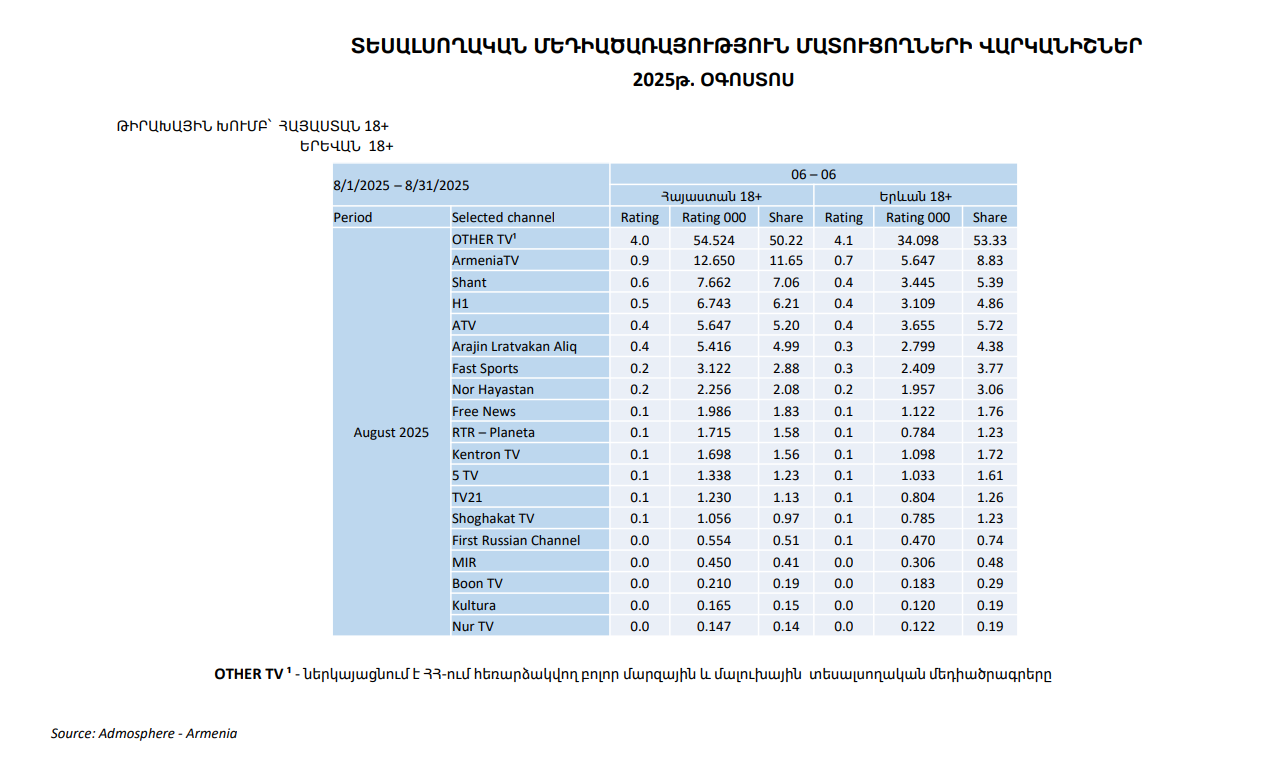
Russian channels in Armenia have lower ratings compared to many local TV companies. However, according to data published by the CTR in August of this year, RTR Planeta ranked among the top ten in terms of audience size.
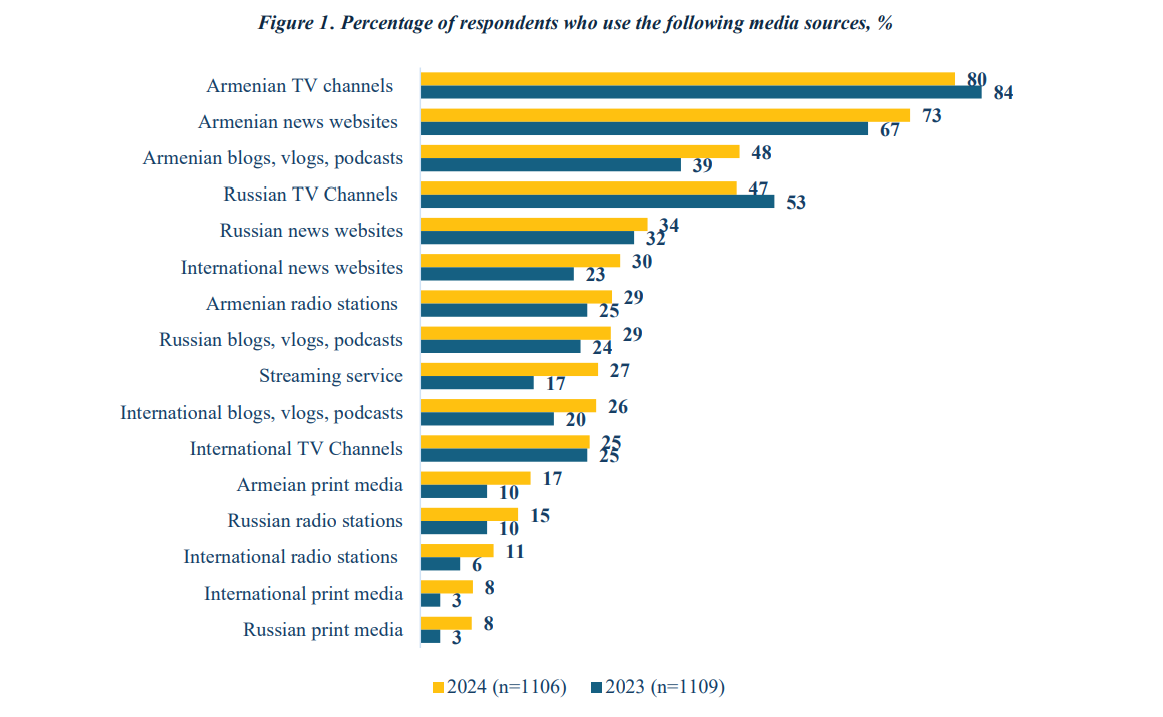
 According to Internews’ 2024 “Annual Survey on Freedom of Speech and Media Consumption in Armenia,” 47% of respondents use Russian TV channels as a media source, 34% use Russian news websites, and 29% use Russian blogs, vlogs, and podcasts.
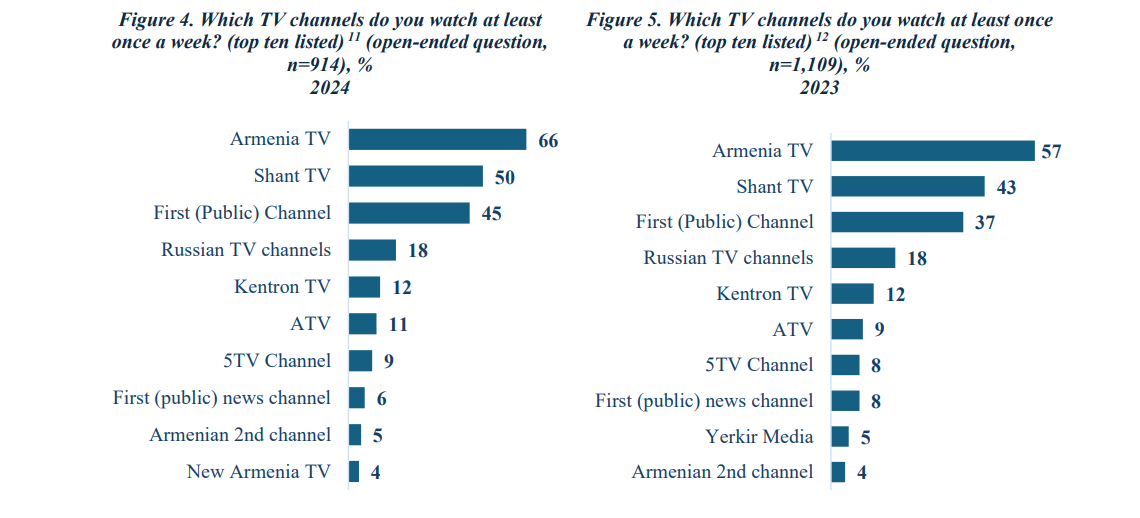
18% of respondents said they watch Russian channels at least once a week.
Discussions have been ongoing for the past two years regarding the free availability of Russian channels on Armenian airwaves. The topic of removing these Russian channels from the public multiplex is currently being addressed in both official and expert circles.
Russian information influence via the public multiplex
On January 15 of this year, the Armenian Ministry of Foreign Affairs delivered a note of protest to the Russian Ambassador to Armenia. According to the Ministry, the protest was prompted by the broadcast of “artificially generated narratives against Armenia’s sovereignty and territorial integrity” in the Weekly News program on the Russian RTR Planeta TV channel.
Two Russian state propaganda programs aired on RTR Planeta — Evening with Vladimir Solovyov and Sunday Evening with Vladimir Solovyov — have not been broadcast in Armenia since April 2024. The Armenian Television and Radio Broadcasting Network decided to ban these programs due to ongoing violations that have been recorded in recent times. In parallel, Armenia’s major cable networks have also decided to take these programs off the air.
The free broadcasting of Russian channels in Armenia has become a topic of discussion in the National Assembly this year. On June 18, NA Speaker Alen Simonyan commented on the Evening with Vladimir Solovyov program aired on the Russia-1 TV channel. During the show, Solovyov had discussed the arrest in Yerevan of Russian businessman and head of the Tashir Group, Samvel Karapetyan, calling the Armenian authorities — particularly Prime Minister Pashinyan — scoundrels, sellouts, and “turkophiles” (pro-Turkish).
“This constitutes direct interference in the internal affairs of the Republic of Armenia, and is a deliberate spread of hatred and insults towards its leadership and people,” stated Alen Simonyan.
Tigran Hakobyan, the chairman of Armenia’s broadcasting regulatory body, the CTR, stated that according to point 5 of the agreement regarding the broadcasting of Russian channels on Armenian airwaves, both Armenia and Russia are required to exclude programs that are offensive to the values of their peoples. Additionally, content that interferes with domestic political affairs is also deemed unacceptable. Hakobyan pointed out that the channels RTR Planeta and Russian-1 regularly violate these stipulations.
On December 20, 2023, the CTR suspended the license of Sputnik Armenia for 30 days due to violations and fined its Yerevan broadcaster, Tospa, 500,000 drams. The decision cited that during one of the programs, the author and host used mocking and derogatory language toward the Republic of Armenia and its people. The Commission stated that a political commentator and host who is a foreign citizen does not have the moral right to make such judgments. In another program, opinions and statements were voiced that not only did not correspond to reality but also appeared capable of provoking panic among the Armenian public. The Commission also noted that the program contained information that was unreliable, insufficiently verified, or based on unchecked sources.
Boris Navasardyan, who has decades of experience in the media sector and heads the Yerevan Press Club, believes that Armenia should refuse to broadcast Russian channels. He states, “We have allocated three channels for Russian programs. As a result, three Armenian TV companies cannot be included in the public multiplex because those channels are being used by the Russian networks. In return, our viewers are subjected to insults about their country and people.”
Navasardyan argues that the intergovernmental agreement signed between Armenia and Russia, which governs the operation of these TV companies, should be reviewed and terminated.
The Armenian government has not taken any direct steps to cancel the agreement regarding the terrestrial broadcasting of Russian channels. Recently, the Ministry of High-Tech Industry proposed a legislative amendment that would give the CTR the authority to regulate the content broadcast by network operators. Currently, the number of Russian channels available through these operators is significantly higher than that in the public multiplex. While the amendment will enhance the CTR’s ability to manage Russian-language content in Armenia, it does not address the issue of Russian state channels in the public multiplex.
In recent years, Russian media influence has been increasing, particularly through social media platforms like Telegram. Russian Telegram channels, some of which have hundreds of thousands of subscribers, are disseminating propaganda aimed at Armenia. One notable channel, Rybar, which has 1.4 million subscribers, recently produced and aired a propaganda film about Armenia as part of its efforts to influence the post-Soviet space.

In Armenia, people get more political news from social networks than from television.
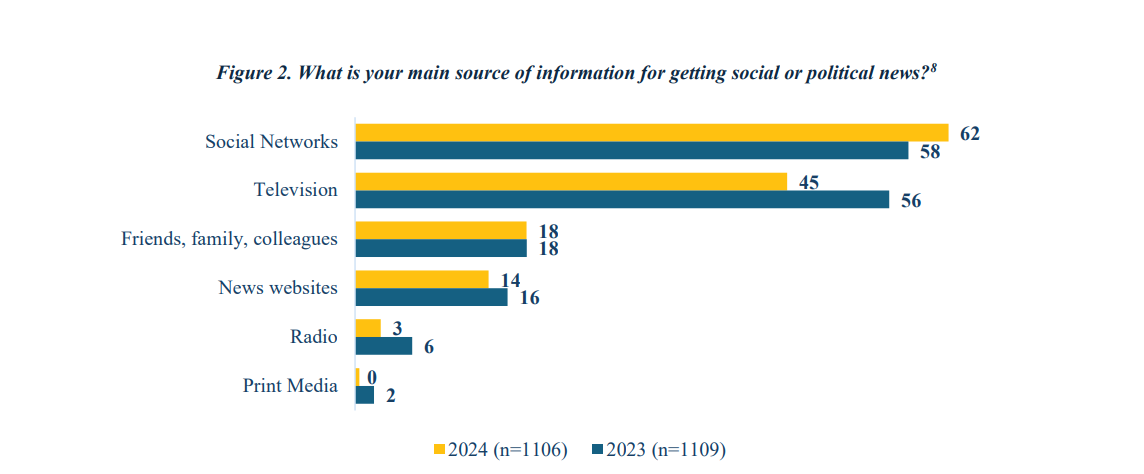
According to the Annual Survey on Freedom of Speech and Media Consumption in Armenia, 62% of respondents in 2024 said that social networks were their main source of news, while 45% cited television. That year, television trailed social media by 17 percentage points. This trend is likely to persist, meaning that countering Russian media influence in Armenia will require measures beyond simply regulating broadcast channels.