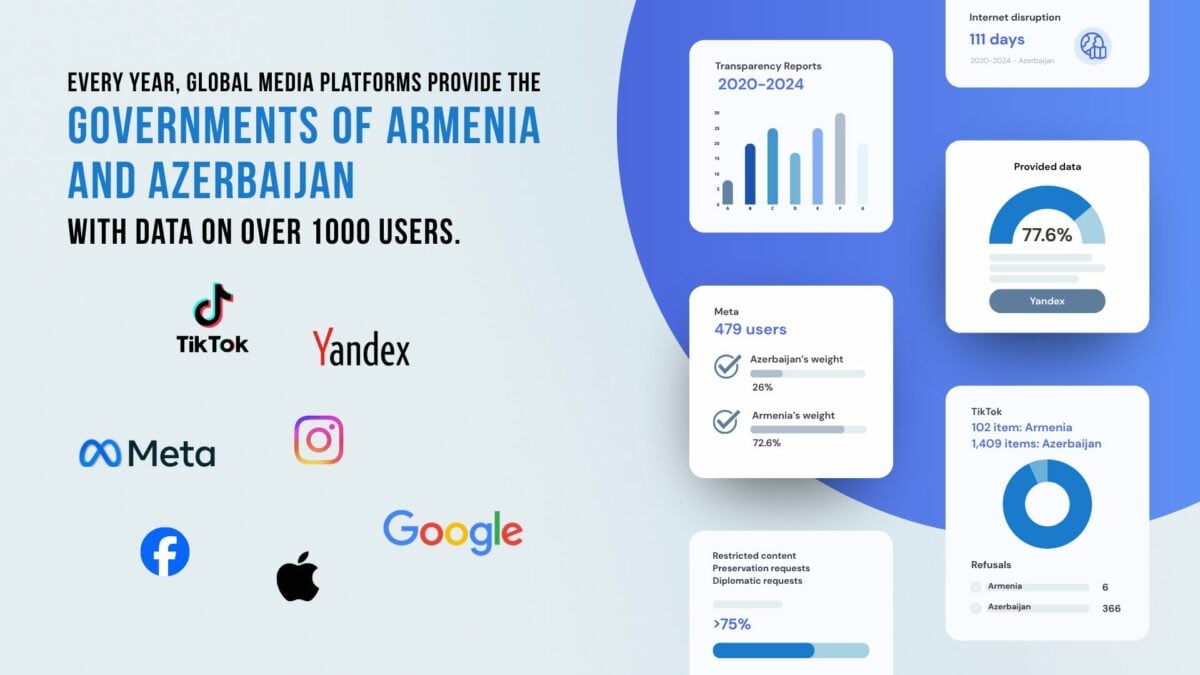
Transparency reports from global digital platforms show how often and how much the governments of Armenia and Azerbaijan have requested user data or the removal of content from social media companies.
We have gathered data from the transparency reports of Meta, TikTok, Google, Apple, and Yandex for the years 2020 to 2024. This data covers various aspects, including content and user blocking, requests for user and account information, internet shutdowns, anti-government and pro-government media campaigns, and demands from the Federal Service for Supervision of Communications, Information Technology and Mass Media (Roskomnadzor or RKN).
Note: Social media platforms release two semi-annual reports each year. The data presented in this article is calculated on an annual basis, and the percentages represent the actual weights derived from the semi-annual data. As a result, they may differ from the semi-annual data available in the sources.
TikTok
TikTok provides several transparency report subtypes highlighting data on the governments of Armenia and Azerbaijan over the past five years.
Covert Influence Operations
We have gathered data on hidden influence activities that the platform successfully prevented, ensuring transparency and integrity.
In July 2024, the platform reported that it had discovered a series of covert operations operating in Azerbaijan and targeting Azerbaijani audiences. The individuals behind the network created inauthentic accounts in order to artificially amplify favorable narratives about the current Azerbaijani administration. Members of the network were typically found to use images of the Azerbaijani state coat of arms as account profile pictures. The platform blocked 51 accounts with a total of 31,090 followers following this discovery.
A few months later, in October 2024, the platform uncovered another series of internal covert operations, this time in Armenia, targeting the Armenian audience. In this case, too, the individuals behind the network created inauthentic accounts to artificially amplify narratives critical of the current administration. In the report, the platform highlights that the network was found often to use images of Garegin Nzhdeh as account avatars. As a result of this finding, the platform blocked 132 accounts with a total of 88,667 followers.
Government Removal Requests Report
TikTok’s transparency reports show how governments respond to requests to remove or restrict content. The company says it evaluates such requests based on its community guidelines and local (requesting country) laws. If the content violates the laws of a given country, TikTok may restrict its availability only in that country. Requests that lack a legal basis or do not violate the platform’s rules are declined.
TikTok’s transparency data reveals that in recent years, both Armenia and Azerbaijan have consistently approached the platform with requests to remove content or restrict accounts.
In 2023, the Armenian government submitted 10 requests involving one piece of content and eight user accounts, achieving a 100% satisfaction rate. In 2024, the number of requests rose to 21, encompassing 45 pieces of content, of which 42 were removed for violating the platform’s rules. The overall removal rate was 90.8%, indicating that TikTok generally fulfils Armenia’s requests when they comply with both the law and the platform’s internal guidelines.
Azerbaijan had the highest number of content removal requests. In 2023, there were 50 government requests involving approximately 196 pieces of content and 63 accounts, resulting in an 83.4% removal rate. However, in 2024, the number of requests surged to 131, leading to the removal of 430 pieces of content and the suspension of 445 accounts.
Of the total content removed, 229 posts were taken down for violating platform rules, while 66 were removed under Azerbaijan’s internal legislation. Among the accounts, 248 were suspended for breaching platform rules, and 69 were removed under the country’s internal laws. Overall, the removal rate for the year was around 70%.
Over the past five years, Armenia has submitted 35 requests to TikTok, listing 54 pieces of content and 48 user accounts. In contrast, Azerbaijan has submitted 205 requests, which included 809 pieces of content and 600 user accounts.
Thus, Azerbaijan submitted requests at a rate four times higher than Armenia, mentioning content 15 times more frequently and identifying 13 times more accounts. TikTok rejected 203 requests for Azerbaijani content, compared to just 3 for Armenian content. Regarding user accounts, 163 requests from Azerbaijan were dismissed, whereas only 3 from Armenia.
Information Requests Report
TikTok’s Information Requests Report reveals that the platform frequently receives requests from governments and law enforcement agencies to disclose, preserve, or remove user data and content. The company states that it only complies with these requests when there is a legal basis for them or when they pose an imminent threat to human life or safety. The report also emphasises TikTok’s commitment to balancing government requests with user privacy protections while maintaining transparency and compliance with the law.
Government requests for TikTok user data highlight a notable contrast between Armenia and Azerbaijan.
Armenia had not made any data requests until 2022, whereas Azerbaijan submitted only one request during the same timeframe. In 2023, there was a slight increase in data preservation requests from both countries. In 2024, Armenia submitted 13 requests, all of which were for data preservation. These requests came from law enforcement or government bodies asking a platform to temporarily store user data without transferring it until a subsequent legal step, such as obtaining a court order, is completed. This trend indicates that over the past two years, Armenia has begun to utilize legal tools more systematically to preserve digital evidence and request data for law enforcement purposes.
In the same year, Azerbaijan submitted 27 data requests. Out of these, 7 were legal requests involving 13 accounts, 19 were emergency requests involving 20 accounts, and 1 was a data retention request. The platform responded positively to only about 21% of the emergency requests; the rest were dismissed. This indicates that a significant portion of the requests from Azerbaijan lacked proper documentation and justification, which is why the platform declined to provide the requested data.
Meta
Meta also has several subtypes of transparency reports. We have highlighted data related to the governments of Armenia and Azerbaijan over the past five years. This data pertains to the company’s Facebook Messenger and Instagram services.
WhatsApp has a separate reporting format regulated by the EU Digital Services Act, which applies only to EU member states. Threads’ transparency infrastructure is not yet fully regulated.
Government Requests for User Data
Meta’s transparency reports reveal how governments seek access to user data on the platform. The company states that it adheres to strict procedures for reviewing these requests, ensuring they have a legal basis and comply with applicable laws. Meta may deny a request or ask for clarification if it is too expansive or vague.
These reports offer insights into both the number of requests and the level of satisfaction, demonstrating how frequently the platform partially or fully meets the requirements set by government agencies.
Meta’s transparency data reveals that both Armenia and Azerbaijan frequently reach out to the platform with requests for user data disclosure. However, the nature and scope of these requests vary significantly. The information sought in these requests falls into two primary categories: legal and emergency.
Between 2020 and 2024, the Armenian government submitted 139 requests to Meta regarding 230 users. The most active year was 2020, with 37 requests; however, the number has decreased in subsequent years and stabilised at an average of 20 to 30 requests per year. Most requests from Armenia were made through legal procedures, such as judicial or investigative bodies. The percentage of data Meta provided in response to these requests ranged from 56% to 82%, with an overall average of 72.6%. This percentage was particularly high in 2021, 2022, and 2023.
The Azerbaijani government has submitted 73 requests to Meta during the specified period, concerning 249 users or accounts. However, the data provision rate for Azerbaijan is significantly lower, ranging from 0% to 70%, with the actual rate being 26%. This may be attributed to requests that are either not entirely legitimate or phrased in a vague manner.
These figures show that the Armenian government collaborates with Meta through more predictable legal procedures, while Azerbaijan engages through irregular and extensive inquiries.
Content Restrictions Based on Local Law
This Meta data outlines instances where content is restricted solely at the national level due to violations of a country’s laws. This means that while the publications do not infringe Meta’s internal guidelines, they violate local regulations and are consequently unavailable in that specific country. These restrictions are implemented based on reports from governments, courts, regulators, or citizens.
In the past five years, Meta has received one request from both Armenia and Azerbaijan to impose content restrictions at the national level. According to the report, the request from Azerbaijan was made in the first half of 2021, while the request from Armenia was submitted in the first half of 2024. However, the report does not specify the nature of the content involved in these requests.
This report outlines several global restrictions imposed across Meta’s platforms, which are not specifically linked to the governments of Armenia and Azerbaijan.
Internet Disruptions
According to Meta, internet outages refer to intentional restrictions that prevent citizens from accessing the internet or specific websites and applications due to government or agency actions. These incidents not only disrupt people’s ability to communicate and obtain information but also have a detrimental effect on human rights, businesses, and media organizations. Meta actively monitors the availability of its platforms and publishes data on confirmed outages to ensure that these incidents are documented publicly.
Meta has not reported any cases of internet outages or Facebook blocks in Armenia over the past five years. In contrast, Azerbaijan experienced two incidents in 2020, affecting both Azerbaijan and Nagorno-Karabakh, totalling 3 months, 20 days, and 7 hours. The first nationwide outage in Azerbaijan occurred from September 27 to November 11, lasting 44 days; this period coincided entirely with the second 44-day war in Nagorno-Karabakh. The second outage, which affected Nagorno-Karabakh, lasted from September 29 to December 3, for a total of 67 days and 7 hours.
In Google’s case, the transparency reports are much more comprehensive and detailed. These reports also specify which government departments or state bodies have requested information. We have outlined data on the governments of Armenia and Azerbaijan over the past five years.
Diplomatic legal requests
This section outlines the number of user data requests identified as submitted through diplomatic channels. These requests include situations in which one country’s government formally requests information from another under a Mutual Legal Assistance Treaty (MLAT).
According to this Google report, Azerbaijan has not submitted any requests, while Armenia has made a total of 36 requests, averaging 7.2 requests per year, through diplomatic channels with the United States.
Government requests to remove content
Courts and government agencies worldwide frequently request that Google remove specific information from its platforms. We analyzed Google’s transparency reports on these requests to determine how frequently and on what grounds government agencies in Armenia and Azerbaijan have made them.
Google assesses each request to determine whether the content should be removed for violations of the law or company policies.
Google’s transparency data reveals that Azerbaijan far surpasses Armenia in the number of content removal requests. Between 2020 and 2024, Azerbaijan submitted 105 requests to Google, primarily targeting YouTube content. These requests were based on claims of defamation, national security concerns, government criticism, hate speech, and the use of fake identities. This trend highlights the controlling nature of the country’s information policy, where online content is frequently perceived as a matter of security or state control.
The Armenian government submitted seven requests during this period, primarily regarding copyright and personal data protection.
The transparency report categorises the different government agencies that made these requests, detailing the amount of content involved and the decisions Google made in response.
ԸնդAzerbaijan submitted 105 requests to remove 1,301 pieces of content. In contrast, Armenia submitted 7 requests to remove 135 pieces of content. The classification database of those submitting requests from Azerbaijan includes government officials, information and communication agencies, police, judicial bodies, and other organisations. For Armenia, the requests are only attributed to government officials and information and communication agencies. Notably, in the 2024 data for Azerbaijan, there are 2 requests made to Google from entities classified as “Other,” which involve a total of 999 pieces of content.
Global requests for user information
Government agencies worldwide operate under various legal frameworks that permit them to request user data for civil, administrative, criminal, or national security reasons.
Global reports published by Google detail the number of such requests received and the legal grounds on which they were made.
This report includes requests made by government agencies that were granted access to data as qualified by applicable law.
The report involves only Azerbaijan, as Armenia did not submit any requests. In total, Azerbaijan made 26 requests, identifying 54 accounts. The disclosure rate for these requests was approximately 39%. This percentage is calculated based on the number of requests submitted, rather than the number of users or accounts identified in each request.
Apple
Government requests for user data, device information, and financial identifiers
Apple is dedicated to transparency regarding government requests for user data and its responses to them. The company releases a transparency report biannually, which outlines the number of government requests for user data it receives globally. The report categorises these requests into four main types: account retention, account information, device information, and financial identifier requests.
In 2021, Armenia submitted one request in each category, except for the financial identifier category. In contrast, Azerbaijan submitted requests in the same four categories only in 2023 and 2024, with a total of seven requests. Apple fully complied with requests for account maintenance and account information from both Armenia and Azerbaijan. Additionally, Apple provided information regarding Armenian devices but rejected two of Azerbaijan’s requests, which included six devices. Apple also denied both of Azerbaijan’s requests for financial identifiers.
Yandex
Yandex’s non-transparent report, in global indicators
In contrast to other social media platforms, Yandex’s transparency reports have faced criticism from the international community, human rights organisations, and journalists for lacking transparency. The data released by Yandex is presented only at the global level and is not broken down by country. This lack of disaggregation creates significant technical challenges regarding transparency, accountability, integrity, and fact-checking.
Moreover, Yandex’s transparency report includes a section dedicated to RKN and is updated quarterly. However, it does not retain documented information from previous quarters, which undermines the principles of open information sharing and transparency that are supposed to be upheld.
Below, we present the data from the platform’s global reports:
Requests for user information on our core services
Between 2020 and 2024, Yandex received a total of 266,055 requests from government authorities and provided data in 206,569 cases, i.e. 77.6%. By service category, the figures are as follows:
- Email (Mail): 57,536 requests, of which 46,419 (80.7%) were fulfilled
- Yandex ID: 12,366 requests, of which 7,183 (58.1%) were fulfilled
- Ridetech (taxi, delivery, scooters, drive): 154,981 requests, of which 122,320 (78.9%) were fulfilled
- Foodtech (food, Lavka, delivery): 32,387 requests, of which 25,155 (77.7%) were fulfilled
- Verticals (real estate, jobs, Auto.ru, travel): 2,145 requests, of which 1,186 (55.3%) were fulfilled
- Location data (geo): 3,552 requests, of which 2,882 (81.1%) were fulfilled
- Media: 447 requests, of which 222 (49.7%) were fulfilled
- Other: 2,641 requests, of which 1,202 (45.5%) were fulfilled
In the largest data categories, a steady year-on-year increase is apparent, raising growing concerns about the methodology used to present these figures in the transparency report at a global level.
Requests to delist content under the “right to be forgotten” law
This section provides data on requests to remove links from search results under Russian Federal Law No. 264, enacted on July 13, 2015, commonly known as the “right to be forgotten” law. This law requires search engines to remove links to illegal, inaccurate, or outdated information about the individual making the request.
The data below shows the number of URLs requested for removal from Yandex Search, organised by the categories of reasons for the requests.
Some URLs may have multiple reasons for removal, resulting in their inclusion in several categories. Consequently, the total numbers for different categories do not align with the overall count of URL removal requests. The statistics reflect only those requests submitted electronically and that fully complied with Yandex’s procedural requirements.
In total, we see 115,255 requests, of which 48,336 (41.9%) were granted.
Roskomnadzor requests for content removal
As previously mentioned, the data on RKN in Yandex’s transparency reports only cover the last six months, and the platform does not provide information from earlier periods. It is important to note that in the second half of 2024 alone, the platform blocked approximately 375,000 links. This is a significant number and reflects the authoritarian nature of the Russian authorities, which has left society somewhat isolated from the global context.
While we can find summary information from earlier periods in other sources, we believe that the most recent six months are sufficient to understand the current situation.
Thus, we have consolidated the data on Armenia and Azerbaijan from the transparency reports of TikTok, Meta, Google, Apple, and Yandex for the period 2020–2024 (excluding Yandex’s global indicators). These figures can be linked to various events and political developments that took place in both countries during that timeframe. Comparing these datasets across different platforms for the same period and conducting follow-up communication with state authorities to obtain clarifications will take place in the near future. This process may shed light on the grounds for requesting user data, the types of content deemed undesirable, and the extent to which these decisions are justified and aligned with human rights principles.
Alexander Martirosyan
This article was prepared with the financial support of the European Union. The content of this publication is the sole responsibility of the author and does not necessarily reflect the views of the European Union.