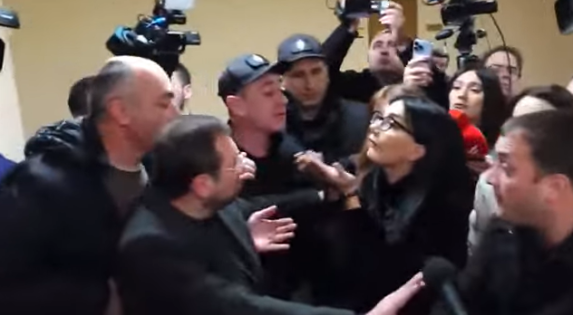
On January 16, security officers at the National Assembly removed journalists from the “Zhoghovurd” daily newspaper from the parliament building.
Journalists Knar Manukyan and Sona Grigoryan, whose National Assembly accreditation has been suspended for one year since late December, entered parliament using passes issued by opposition MP Gegham Manukyan and attended a session of the Defense and Security Committee. However, during the session, the SPS officers informed the journalists that they were not authorised to be present. The situation escalated, and Knar Manukyan was forcibly removed from the premises.
Sona Grigoryan stated in an interview with Media.am that they were authorized to be present wherever MP Gegham Manukyan, who issued them a pass, was present. He was participating in the session from which they were expelled.
“When the SPS first asked us to leave the session, the chairman of the committee, Andranik Kocharyan, said that we were not disturbing and could remain present. However, shortly after, they called him out and insisted that we had to leave. The head of the staff, Davit Arakelyan, came in person and waited for the SPS to carry out the order and remove us,” said Sona Grigoryan.
Davit Arakelyan clarified that journalists who enter the building with a pass are permitted to meet the Member of Parliament (MP) who issued the pass only in the MP’s office and only if they are accompanied by the MP or the MP’s assistant. After the meeting, the journalist must leave the building.
When reporters inquired whether a journalist could attend a committee meeting with the MP who issued the pass, Arakelyan emphasized that the rules are clear. He urged journalists to read the document they signed again, noting that committee chairs are not authorised to permit journalists who are not officially accredited to attend committee sessions.
Sona Grigoryan considers both the recent incident and the revocation of their accreditation last December to be unlawful. “In a single day, Davit Arakelyan issued two reprimands simply because we attempted to approach MP Hayk Konjoryan in the designated area to ask him a question,” Grigoryan explained. According to the journalist, they initially asked officers from the SPS whether they were permitted to ask questions there, and were told they could. “We tried to interview him, but he didn’t stop or respond to our questions, and for that, we were reprimanded,” she stated. Grigoryan added that later that same day, they received another reprimand for an earlier attempt to ask the same MP a question in the same place, which was issued retroactively. She mentioned that they have challenged the decision in court, as they wish to continue covering the work of parliament, especially with the new legislature that will be formed after the elections.
Sona Grigoryan stated that she and her colleagues visited the National Assembly of Armenia as private citizens and were not engaged in any journalistic activities that day. “We did not film anything or publish anything; we went simply to listen to the draft law proposed by MP Hayk Sargsyan,” she explained.
Ashot Melikyan, the Chairman of the Committee for the Protection of Freedom of Speech (CPFS), expressed his concerns to media.am about the troubling trend: this is not the first time journalists have had their accreditation suspended due to conflicts in parliament.
“Whenever a tense situation arises in parliament, or there is an argument with a journalist, an outraged MP often takes steps to revoke the journalist’s accreditation. This has become a common practice. They issue formal warnings and then suspend the accreditation. But are these warnings, which serve as the basis for revoking accreditation, legitimate? We have had cases in the past that were addressed by the Information Dispute Council, where warnings issued to journalists were unlawful. For instance, a warning was issued to a journalist for filming security guards entering the session hall. These security guards had previously been filmed multiple times during the live broadcasts of the parliament,” emphasized Ashot Melikyan.
The chairman of CPFS disagreed with the NA Chief of Staff’s observation that the law prevents a journalist from participating in a committee session if they enter parliament with a pass.
“They say that if Gegham Manukyan invited journalists or provided them with a pass, they were only allowed to visit his office. However, journalists were also permitted to attend the committee sessions, as evidenced by President Andranik Kocharyan’s initial lack of objection to their presence. There is nothing in the regulations that states they are restricted to only visiting the office,” said Melikyan.
Sona Grigoryan called on the journalistic community to unite and apprehend that the events taking place concern not only them, but everyone. “Those who dare to ask uncomfortable and unwanted questions of government officials will face similar consequences. This is an attempt to silence the fourth estate ahead of the upcoming elections.”
Ashot Melikyan added that he is concerned that no efforts are being made to ease the tension between journalists and government officials; in fact, the situation seems to be worsening. He noted, “At times, journalists can be overly aggressive or too persistent with officials who do not wish to be interviewed. On the other hand, we observe that officials who usually maintain their composure can suddenly lose their temper over minor issues. This problem must be solved; the conflict resolved. Otherwise, during the elections, the National Assembly will become a stage for gladiatorial battles,” summarized the CPFS chairman.
Journalistic organizations have also called for easing the tensions.
“The facts show that strained relations are causing significant communication difficulties between employees of opposition media outlets and representatives of the ruling party. Similarly, journalists from government-affiliated media are facing challenges in communicating with opposition figures. It is evident that this is also a consequence of deep polarization in the media landscape and the servicing of political interests. However, the National Assembly has yet to take meaningful steps to improve this situation, despite our long-standing offers of support,” their statement reads.
Journalistic organizations demand that the National Assembly leadership “initiate discussions to create a code of conduct regulating the relations between journalists and MPs accredited in the NA and to form a body to monitor compliance with the requirements of that code.”