
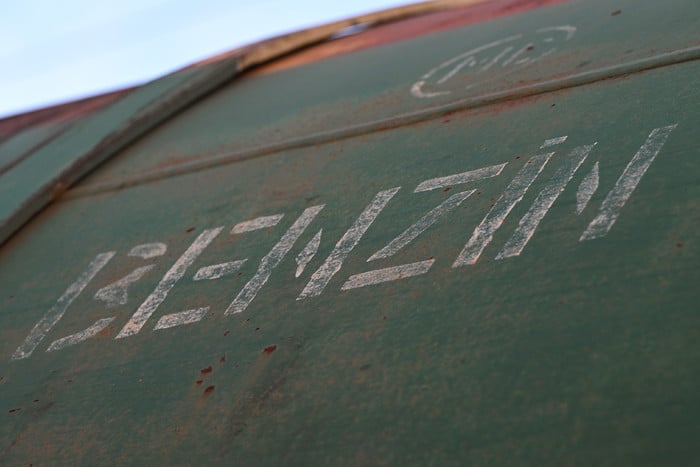
A train loaded with oil products has arrived in Armenia from Azerbaijan. This government statement, issued on December 19, included pictures of the train, showing that the wagons contained gasoline transported through Azerbaijani roads. Earlier, on November 6, a grain train that also transited Azerbaijan arrived in Armenia. To receive the train, the Minister of Territorial Administration and Infrastructure, David Khudatyan, visited Ayrum station in the Tavush region.
Grain and oil products have entered Armenia from Georgia, notably passing through Azerbaijan. The government presents this as a step to stimulate the economy, emphasizing that it “fosters mutual trust between the two countries and supports the peace agenda.”
The agreement to transport 22 wagons of gasoline to Armenia was reached by the Deputy Prime Ministers of Armenia and Azerbaijan, Mher Grigoryan and Shahin Mustafayev, on November 28 in Gabala.
The news of importing grain and oil products into Armenia through Azerbaijan initially sparked discussions framed by the question, “How can you import goods from an enemy?” The discussion surrounding the first imported grain became heated when it was revealed to be of low quality, classified as fourth grade. However, interest in subsequent grain imports has noticeably diminished. As of now, the last grain import through Azerbaijan occurred on December 23, according to Economy Minister Gevorg Papoyan, who expects more imports in the near future.
There was no possibility of boycotting grain that passed through Azerbaijan, regardless of its quality. However, gasoline was facing a possible boycott, according to media reports. Gevorg Papoyan spoke about the potential consequences of such a boycott, emphasizing, “We only offer diversity.”
Azerbaijani oil products are sold at “Ran Oil” gas stations for 430 AMD. These stations are owned by Khachatur Sukiasyan’s family, who is a deputy from the “Civil Contract” faction in the National Assembly. Typically, the price of this gasoline ranges from 500 to 520 AMD. The media has not reported any boycotts against this cheaper fuel. Meanwhile, according to “Azatutyun,” sales of this low-cost fuel have increased fourfold.
In an interview with Levon Kocharyan, a deputy from the “Armenia” faction of the National Assembly, Hayka Aloyan, the host of Channel 5’s “Interview” program, notes, “Unfortunately, Azerbaijani gasoline is being consumed quickly.” Kocharyan argues that the authorities are good at “packaging something nonexistent as a major achievement.” He points out that Armenia is supporting Azerbaijan by purchasing fuel from them, a situation presented as an achievement. While he acknowledges that importing Azerbaijani products could potentially strengthen Armenia’s economy, the MP questions the morality of such an approach.
“Yes, politics is also about morality,” declares Anna Grigoryan, another deputy from the “Armenia” faction, again, during an interview on Channel 5. According to Grigoryan, “Normalizing relations with Azerbaijan and Turkey is necessary, but as long as our compatriots are being tortured in Baku’s prisons, it is unacceptable to speak about cheap Azerbaijani gasoline.”
Meanwhile, Prime Minister Nikol Pashinyan said during a year-end press briefing that Armenia should express gratitude to Azerbaijan for lifting the ban on transit cargo. According to Factor.am, the prime minister said Armenia must demonstrate its attitude. “I want to demonstrate that peace is real and that it has concrete forms of expression,“ Pashinyan said. “I hope that in the near future there will be bilateral trade between Azerbaijan and Armenia, including exports from Armenia to Azerbaijan.”