
Children in Armenia have long navigated a “two-address” daily life, physical and digital. Social networks, messaging apps, online games, and streaming platforms serve as tools for communication and education, but they also present significant risks. The study “Disrupting Harm in Armenia,” conducted by UNICEF, Interpol, and several other organizations between 2023 and 2024, provides important insights into the online threats children face. While the study addresses specific issues, a significant concern is that we in Armenia have little knowledge not only about the risks but also about what children are doing in the virtual realm.
Even when focusing on just one of the issues highlighted in the report, the figures are alarming for a country with a small population. According to the survey, five percent of children reported experiencing some form of sexual exploitation and abuse through technology in the past year. When we apply this percentage to the total number of internet users aged 12 to 17, it suggests that approximately 9,000 children are affected each year.
In the digital environment, harm does not always begin with direct abuse; it often manifests as normalized “content pollution.” The most common manifestations include:
- Unwanted sexual content: Around 3% of children reported receiving sexually explicit images against their will.
- Requests for intimate images: Children are frequently asked or pressured to send images of intimate parts of their bodies.
- Online grooming and blackmail: Particularly prevalent are cases involving the abuse of trust (grooming) and sexually motivated blackmail.
Where Does It Happen? Platforms and Environments
Many people believe that child safety concerns are limited to “the street” or “school.” However, the reality is quite different: 71% of incidents occur exclusively online, particularly on social media and online gaming platforms.
The social media platforms most often associated with child exploitation or abuse are Instagram and Snapchat, each accounting for 45% of reported cases, followed by TikTok and Telegram.
Facebook was mentioned in only 7% of cases.
The majority of the cases analyzed in the report (69%) were social media-related.
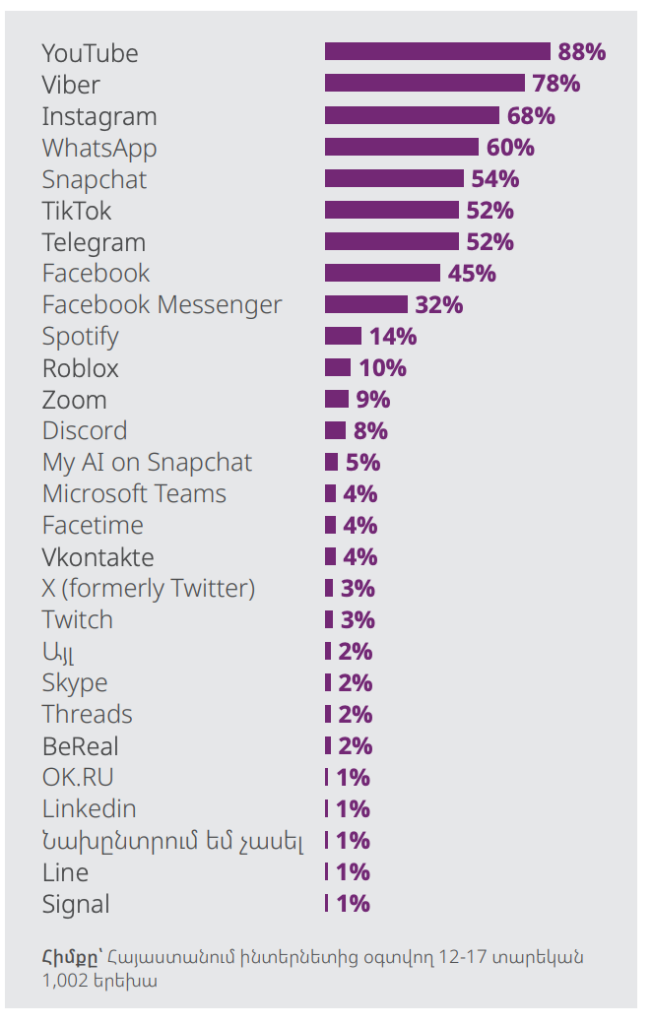
Social networks and gaming apps used by children in Armenia, as of 2023
A significant issue is already evident here. Many parents and teachers are unaware of the various platforms that children use regularly. For example, Snapchat, which has particularly concerning statistics in this report, is largely unfamiliar to older generations in Armenia. As a result, children often do not even expect to receive help when they encounter problems on such platforms.
The barrier of shame and silence
One of the most painful findings of the study is that 53% of children who experience abuse do not tell anyone about it. In most cases, children do not turn to the police or support services for several key reasons:
- Shame and stigma: Children feel ashamed of what happened and fear social judgment.
- Family reputation: Concern that disclosure could harm the family’s honor and reputation.
- Lack of trust: Fear that their privacy will not be protected or that they will be blamed for the abuse.
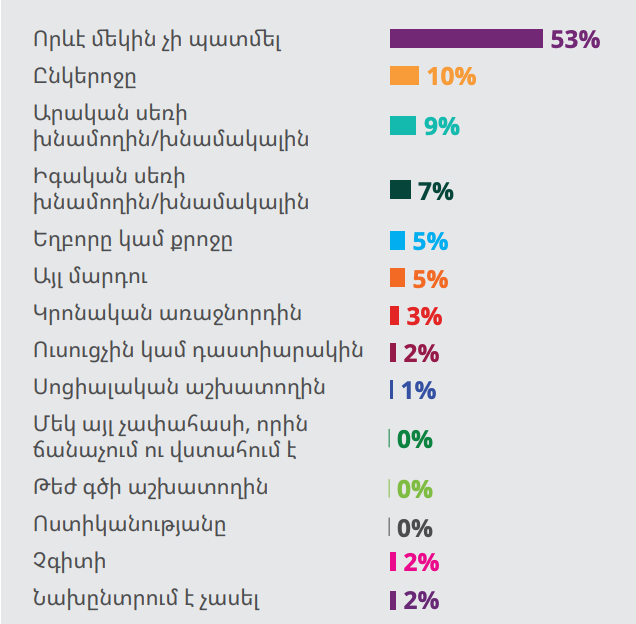
That’s who children turn to in such situations.
Clearly, children do not trust public and state institutions. At the same time, they do not know who to turn to.
Currently, Armenia is at a critical turning point. While all children in the country have access to the Internet, most have only limited knowledge about digital safety. They also tend to distrust adults and public institutions. As a result, they are increasingly exposed to a wide range of risks, including addiction and various forms of digital abuse and attacks. Moreover, society and the state lack the mechanisms to support children in this environment. There is also a lack of a clear, shared understanding regarding the specific problems and risks that children face online.