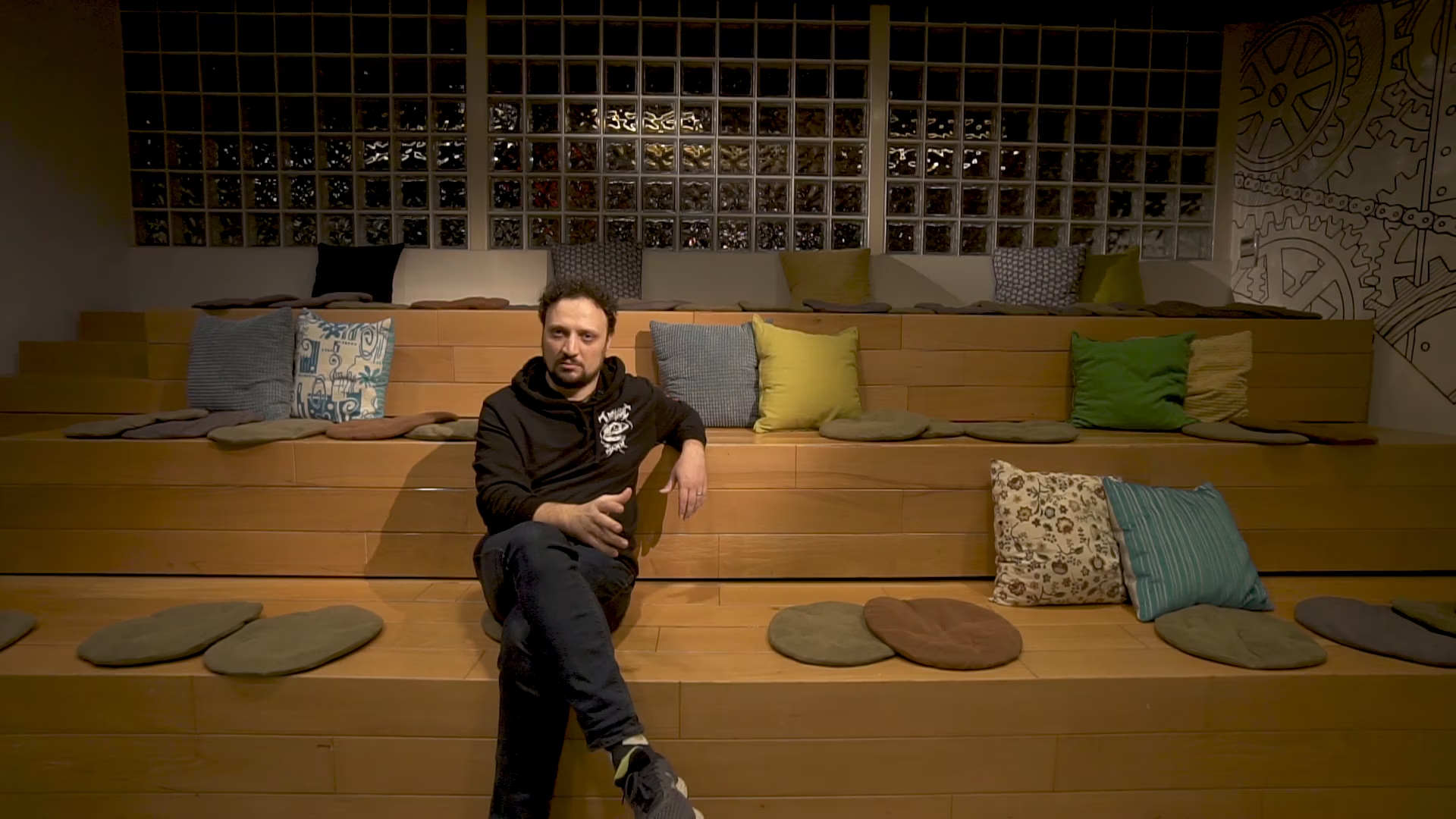
We live in a time when no good text goes unpublished. However, there are still challenges in capturing the readers’ attention. These challenges have been present for the past decade and continue to exist today. Prose writer and editor Artavazd Yeghiazaryan told media.am about this, noting that many books are published and remain unread in bookstores.
What is contemporary Armenian literature like? How would you define it?
Publishers and organizations dedicated to promoting literature might provide a better answer to this question. However, as a writer and a reader, I can say that we have access to modern, high-quality literature that is competitive on an international scale. Unlike film production, which requires substantial financial resources and a large team, literature can be created by an individual author. The author writes, and the publisher handles the publication. Getting published today is easier than it was 15 years ago, leading to the creation of many works that meet international quality standards. We live in a time when no good text goes unpublished. The challenge lies in attracting readers’ attention to these books. This issue was present ten years ago and remains a concern today. Many books are published and remain unread on bookstore shelves.
One would assume social media would have addressed these issues, right?
If we look at the general book market, we see a revival of the tradition of buying books, mainly due to events like the Book Giving Day and Book Fest, which are well promoted and attract active participation. However, individual books and authors often lack dedicated marketing campaigns. These events tend to promote translated works more than Armenian authors. There is a common misconception that Armenian writers produce works similar to Armenian soap operas, so people are often prejudiced—they have an opinion about a book without ever having read it.
Don’t authors utilize available tools? For instance, build their image on social networks and maintain direct contact with their readers?
You are right, it’s a good tool, but not all authors can effectively utilize it. It demands knowledge, skill, and time. Personal branding is a job that requires special attention, and not everyone can do it.
Interestingly, there’s a contrasting trend: bloggers and influencers publish books that succeed. After engaging their audience for years, they release a book—regardless of its content—that often becomes a bestseller.
On the other hand, we have authors like Aram Pachyan, who maintain a low profile with no public social media presence, are quite reserved with readers, and rarely give interviews, yet their books generate significant anticipation. Therefore, I cannot definitively state that an author’s activity on social media guarantees success, nor can I say that inactivity causes failure.
Have you analyzed the success of your book, “The Secret of the Vishap Stone”? What was the driving force behind its sales from a marketing perspective?
On social media, I am known as the editor of Yerevan magazine, so I am confident that my personal page did not influence the book’s sales. I simply ventured into a field that was underserved in Armenia, as there are very few authors creating children’s literature.
When I was selecting books for my son to read, I noticed that all of them were translations; there were no local authors for that age group. This realization inspired me to write it myself.
The book was published in the fall of 2020 as part of the Book Fair. The first readers loved it, and positive feedback quickly spread. The quality of the cover, Harutyun Tumaghyan’s illustrations, and even the font contributed significantly to its appeal. Antares Publishing House did an outstanding job.
I also held meetings with students, which proved to be very helpful. When children hear the word “writer,” they often picture someone from a black-and-white photo in a textbook, long gone. Meeting a real-life writer, especially in sneakers, is quite a shock for them.
Do libraries still serve as a measure of success for writers? Do modern authors want their works to be included in libraries, or are sales the more significant indicator of achievement?
It is indeed gratifying to find a book in a library, especially when on readers’ demand. In contemporary literature, this often happens when there is significant reader demand, prompting libraries to add the title to their collection of newly purchased books. When someone borrows your book from the library, I believe the writer carries greater responsibility than when a reader buys it.
About responsibility: Since the book is intended for children and adolescents, did you hold back on any subjects? Were there any topics or issues that you avoided discussing because you felt the readers might not understand, or because you worried that the line between reality and fiction could become blurred?
The events in my book take place in modern Armenia, but there are also references to myths. There are real places where we have all been, but there are also talking dragons who speak colloquial Armenian. This was the main challenge. I have heard a lot of criticism regarding the choice of language. I have even heard people say that the language is street-level because it is spoken with A-s. Naturally, I disagree with this. We have a stereotype that if it is a printed script, it should not be with a-s.
Many people were horrified that I used the word “չռփել” (“slap”). I believe language is a living organism, and if you’re telling a story set in 21st-century Yerevan, then you should use the language that is actually spoken in that time and place.
Wasn’t there a concern that many children at that age would perceive this as reality, even misinformation, since they might not understand that it was fiction?
No, I haven’t thought about that. Fiction is fiction; I don’t think children need to be told it’s exaggerated and imaginary.
Interviewer: Tigranuhi Martirosyan