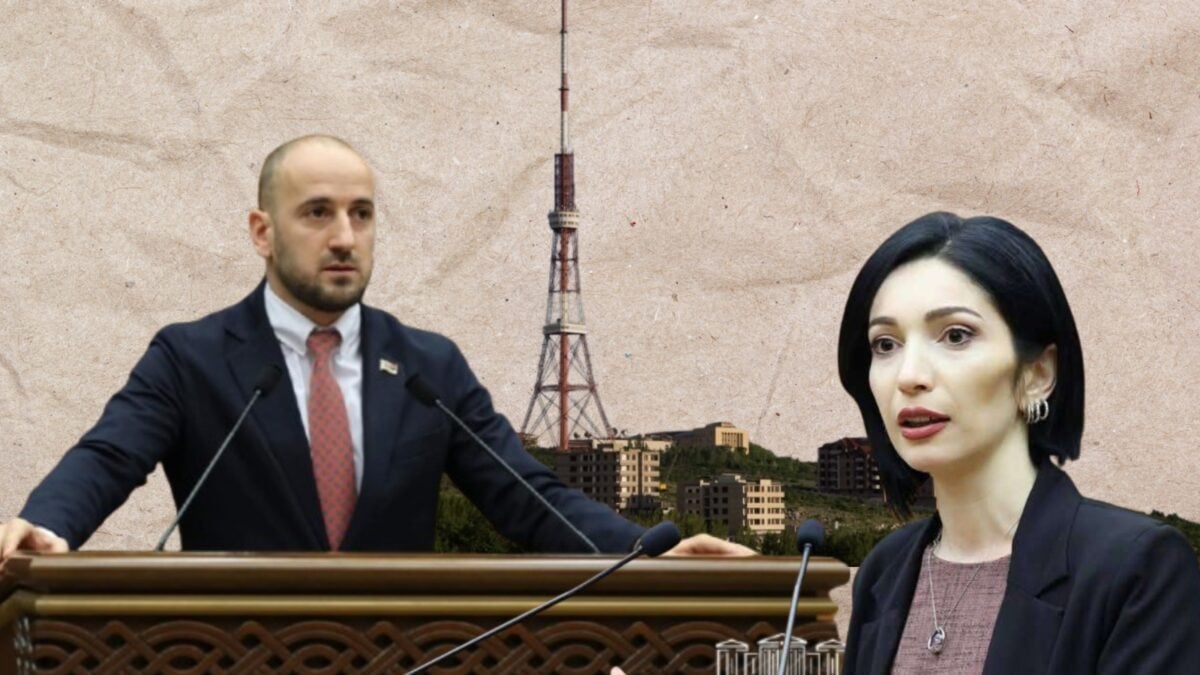
On October 2, the government approved a draft amendment to the Law on Audiovisual Media, proposing to reduce the number of public broadcasters. The bill, introduced by MPs Sisak Gabrielyan and Taguhi Ghazaryan, stipulates that the number of public broadcasters cannot be fewer than two.
Under the current law, there are three public broadcasters in Armenia: the Public Television Company of Armenia, the Public Radio Company of Armenia, and the Spiritual and Cultural Public Television Company. The latter has been broadcasting the “Shoghakat” audiovisual program since January 2011.
The ruling Civil Contract members of parliament have been discussing the need to reduce the number of public broadcasters. Specifically, they aim to cease the operations of the “Spiritual-Cultural Public Television Company,” which airs the “Shoghakat” audiovisual program. This discussion gained traction last year, starting from the launch of Archbishop Bagrat Galstanyan’s campaign calling for the Prime Minister’s resignation.
The justification for the project submitted to the government states that the operation of three public broadcasters under limited resources leads to quality concerns. Content from different broadcasters often overlaps, and the educational and cultural programs attract low viewership. They believe that reducing the number of broadcasters will enable a more targeted allocation of financial resources. This approach could support the operation of two public broadcasters with distinct functions, enhancing their financial stability and the quality of their programs.
On October 6, during the Public TV program “Interview with Petros Ghazaryan,” when asked, “Why are you closing ‘Shoghakat’?”, Taguhi Ghazaryan, the author of the bill, confidently stated that the amendment directly affects “Shoghakat.”
“A few months ago, the ‘Public-Beneficial Media Environment’ fund was established, requiring state funds for investment. If the public contributes to the creation of culturally beneficial media content, it is important for them to understand how their money is being spent. The government approaches us and requests funding for the “Public-Beneficial Media Environmen” , but then it comes back asking for support for another initiative. Decide which one you prefer,” Taguhi Ghazaryan stated.
Public Broadcasting Council’s stance
The proposed change is unacceptable to the Council of Public Broadcasters. In a letter sent to the government, the Council emphasizes that the presence and broadcasting of a separate cultural audiovisual program through a public multiplex are mandatory.
“If the draft law is adopted, the dissemination of cultural and educational content within a separate audiovisual program will no longer be guaranteed through the public multiplex. The “Public Television of Armenia” CJSC already broadcasts two audiovisual programs via the public multiplex. To broadcast an additional audiovisual program, the public broadcaster would be required to participate in a corresponding competition to obtain a license for slot usage and submit a competitive proposal. Under such conditions, it may become impossible for the public broadcaster to ensure the distribution of a culturally and educationally oriented audiovisual program through the public multiplex. In our assessment, however, the dissemination of such content—particularly by the public broadcaster—is essential. The role and importance of culturally focused audiovisual programs are difficult to overstate in the context of preserving national identity and passing on cultural heritage,” the Council’s statement reads.
The Council also addressed the financial aspect, noting that if the dissemination of cultural and educational content is entrusted to the “Public Television of Armenia,” additional funding will be required. The statement noted that the current state funding allocated to the “Spiritual and Cultural Public Television” would, given the existing circumstances, no longer be sufficient to achieve the expected results.
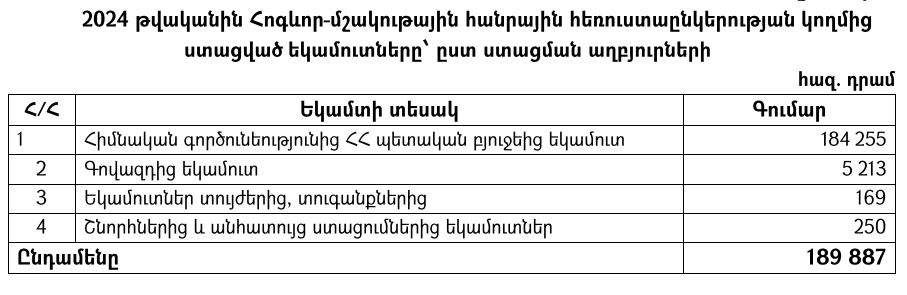
As per the Council of the Public Broadcaster of the Republic of Armenia, based on the annual report on the activities of public broadcasters for 2024, the state budget allocated 221 million AMD to this television company (184 million AMD excluding VAT).
Anna Sargsyan, Acting Executive Director of the “Spiritual-Cultural Public Television Company,” stated that programs produced under state order account for no more than one-third of the channel’s 24-hour content. Nevertheless, the available resources remain insufficient to fully meet even these production needs.
“Even the state-commissioned programs cannot be fully produced with the limited funding provided by the government. It’s obvious that producing a television program requires proper facilities as well as a material and technical base — all of which are supplied by the Mother See of Holy Etchmiadzin,” said Anna Sargsyan.
What does Shoghakat TV broadcast?
In response to ongoing criticism that Shoghakat focuses too much on spiritual content and fails to meet its responsibilities as a cultural channel, she explains that, like all public broadcasters, their network receives approval from the Public Broadcasting Council before each season begins.
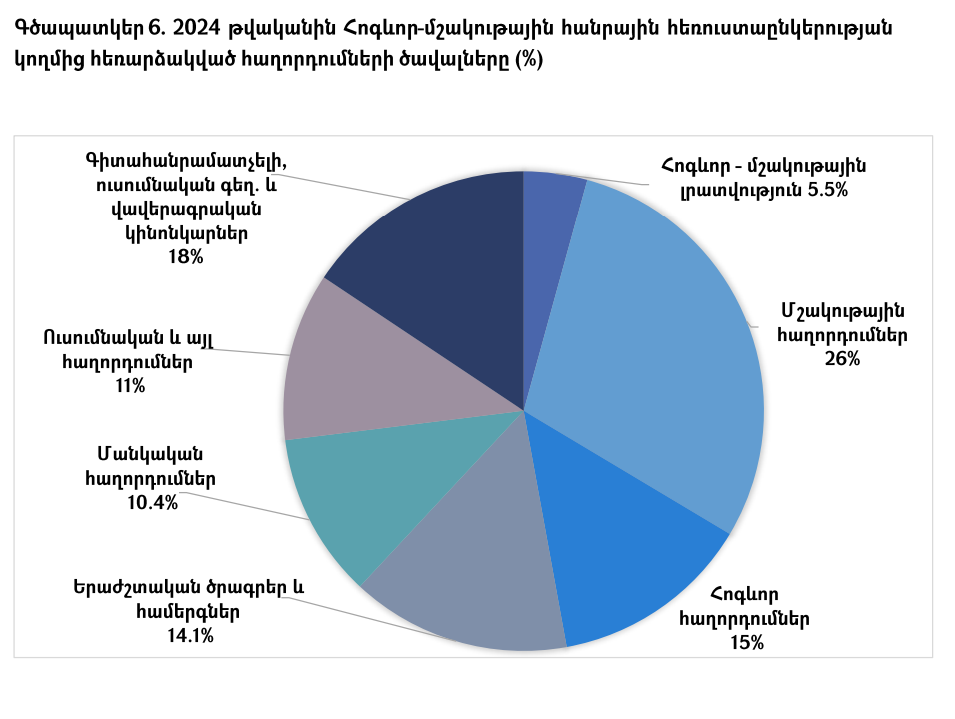
When reviewing the volumes of individual sections of audiovisual programs presented in the annual report by the Council on the activities of public broadcasters for 2024, it is evident that spiritual programs and spiritual-cultural news broadcast by the television company collectively account for 20.5% of the total television content.
“The proposed project infringes upon a fundamental right. It is the state’s positive obligation to maintain a public broadcaster. Armenian citizens pay taxes, in part, to enable the government to establish public television companies, which should include a dedicated cultural channel. This channel should provide media content that is non-commercial and serves the public’s interest. Cultural content, in terms of the television industry, cannot compete with or exceed the viewership of entertainment, news, or political programs. As a result, it is not in the interest of private companies to produce cultural content. Moreover, when state authorities seek to limit or reduce their positive obligations, they are directly harming the interests of citizens, who are the rightful beneficiaries of those obligations. What should a citizen do who wants to consume cultural content, and the state refuses to fulfill its obligation, violating the citizen’s rights?” says Anna Sargsyan.
The Public Broadcasting Council, along with the Ministry of Justice, the Ministry of Finance, the Ministry of Education, Science, and Technology, and the Television and Radio Commission, provided their feedback on the proposed draft.
All four institutions reported that they had no objections, suggestions, or comments.
“The central focus of the Ministry of Education, Culture and Sports’ strategy is improving access to culture. One of the most effective ways to achieve this is through the media. However, there are now proposals to close or reduce this important channel, and the ministry has not provided any suggestions or comments regarding this issue. While the draft law mentions that the European experience was taken into account, it does not specify which countries’ experiences were, taken into account. In this context, the Regulatory Body of the RA RFC, should have gathered expert knowledge and information that would enable comparisons and help suggest the most effective solutions. Unfortunately, it seems they have no recommendations or comments to offer,” says Anna Sargsyan.
CTR Chair on the Issue
Before the government published its summary, the RFC chair Tigran Hakobyan, informed media.am in an interview that no preliminary discussions had taken place with the Commission. He noted that they only received the draft of the law that had already been prepared.”
In our letters and conversations, I have consistently expressed that our Commission, including myself, disagrees with this approach. We firmly believe that the mission of the public broadcaster is to create and disseminate cultural and educational content.”
“Closing the channel that plays such an important role in the current climate of commercialization — closing that kind of window for communication with the public — is, in my view, a mistake. We should look for other ways. If something has failed to justify itself, we need to identify those responsible, find the reasons, and correct the personnel policy. In my opinion, we should find a more effective solution and preserve at least one television program within the public broadcaster that serves to educate our society,” said Tigran Hakobyan
Expert opinion
Boris Navasardyan, the Honorary President of the Yerevan Press Club, perceives political motives behind the proposed legislative changes. He believes that the executive branch’s dissatisfaction with the church is evident and that this initiative aims to restrict the public expression of the church’s activities.
I will not discuss the content of “Shoghakat” or the church’s behavior. However, this has resulted in limited availability of spiritual and cultural programs on our airwaves.
In today’s public multiplex, there is a lack of diverse television content that addresses society’s informational needs. Instead, we are often confronted with polarized, politically biased TV channels, and there is a scarcity of content that serves the public good. To tackle this issue, the government has recently established the “Public Beneficial Media Environment” fund, aimed at promoting more beneficial programs.
Unfortunately, the funds for that initiative are very limited. It is hard to believe that these polarized and politicized TV channels will be able to effectively utilize those funds to create and distribute quality content. This may explain why the significance and value of “Shoghakat” are being overlooked today, as the number of public broadcasters is being reduced based on specific political motivations,” says Boris Navasardyan
Following government approval, the bill is now in the National Assembly, and the “Spiritual-Cultural Public Television Company” is fulfilling its contractual obligations, which will remain in effect until the end of the year.