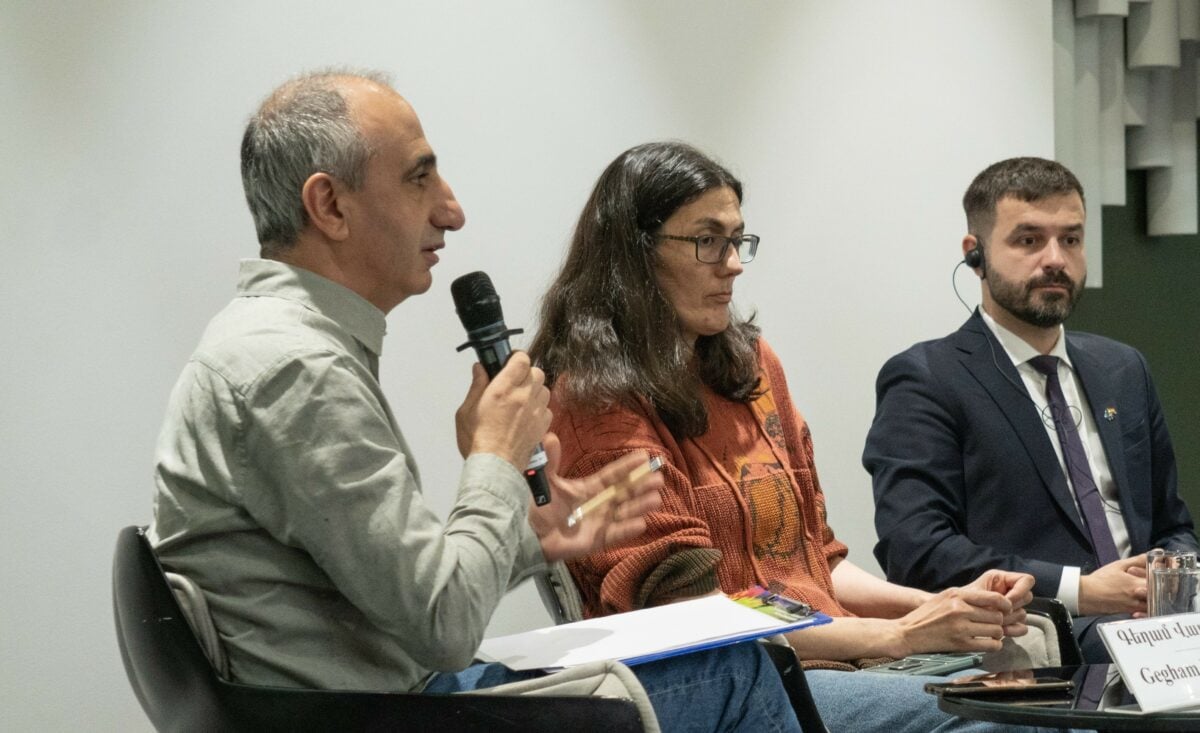

During a press conference on October 7, Robert Kocharyan, the second President of Armenia, commented on the ruling of the European Court of Human Rights (ECHR) concerning the events of March 1. He highlighted that the main point of the decision was the state’s insufficient efforts to investigate and identify the cases of death.
“The 110-page document does not contain the word ‘murder’; instead, it discusses cases of death. If you are looking into this topic, it would be helpful to read the document first. The European Court’s decision states that the state did not make sufficient efforts to investigate these death cases. The lawsuit was filed in 2011, three years after my presidential term, and since then, the state has failed to adequately address the investigation into these cases of death,” said Robert Kocharyan.
Media.am’s fact-checking team, “Verified,” has determined that the statement is misleading. The ruling from the European Court of Human Rights (ECHR), published on September 18, 2025, indicated that Armenia had violated the right to life for the majority of those killed during the events of March 1, 2008.
The Court unanimously concluded that there had been a violation of Article 2 (right to life) of the European Convention on Human Rights concerning the relatives of all the applicants, except for Samvel Harutyunyan and Zakar Hovhannisyan. In their cases, there was insufficient evidence to support claims of violation.
The press release of the European Court of Human Rights (ECHR) concerning this case states, “The victims had been killed by tear-gas grenades fired by police units or by live ammunition. The police actions had been poorly planned, disproportionate and inconsistent. Highly lethal weapons – AK-74 assault rifles, Makarov pistols, and Cheremukha-7 tear-gas grenades – had been used, and the tear-gas grenades had been deployed improperly.”
“The use of lethal force could be justified in certain circumstances under the European Convention, including for the purpose of quelling a riot or insurrection. However, firing 1,405 illuminating 5.45 mm bullets to scare off and disperse demonstrators, as detailed in one of the few documents submitted by the Government, had been clearly disproportionate,” was stated in the press release.
In the ruling, it was stated, “The Armenian authorities had also failed to carry out an effective and thorough investigation into the circumstances of the victims’ deaths. The investigation had given the impression of political bias as it had been directed against the political opposition rather than the police actions.”
The Court also pointed to a lack of public scrutiny and of effective participation in the investigation. The applicants had in practice been excluded from the domestic proceedings and had been almost completely unaware of any developments, apart from certain initial forensic examinations.
The claim that the primary focus of the ECHR ruling regarding the March 1 case is the insufficient investigation of the deaths is misleading. In reality, the ruling emphasizes not only the lack of an effective investigation but also the absence of a fair trial. Additionally, it criticizes the state’s use of excessive force against the victims and highlights the violation of their right to life.